



 download PDF
Introduction
It has long been observed that people living in the Mediterranean countries have lower rates of diseases such as cancer and coronary artery disease compared with populations in other European countries1,2,3. Furthermore, there are studies indicating that the Mediterranean diet (MD) is associated with a reduction in total mortality4,5.
During the last decade, living conditions in European countries have changed considerably. Greece has experienced such changes at a rapid rate over the last 20 years and has moved towards Western ideals. This has affected nutrition and eating habits and studies indicate that people in Mediterranean areas are abandoning the healthy MD6,7. Such lifestyle changes are a major factor in the rapid rise in overweight among many populations; school children in Greece, the US, Ireland and Portugal are among the most overweight internationally8. The increase in weight is most significant among children and adolescents who are exposed to social risk; there is also a connection between overweight parents and overweight children9. According to a WHO statement, one-fifth of all children in Europe are overweight and, of these, one-third is obese. These children are at increased risk of diseases such as type-2 diabetes, hypertension, psychosocial problems and reduced life expectancy10.
Consequently, there is scientific interest in the MD and its presumably preventive and salutogenetic effects on health, and also in how social changes in these societies affect public health. The MD is characterized by low saturated fat content and a high level of monounsaturated fat mainly in the form of olive oil; moderate intake of alcohol (consumed as wine with meals); high consumption of vegetables, fruits, legumes and cereals; moderate consumption of fish, milk and dairy products, mostly in the form of cheese; and low consumption of meat products11.
Most of the studies concerning MD have focused on adults, but a previous Spanish study reported a nutritional index for children, the so called KIDMED-index12. This KidMed-index was devised in order to evaluate children's dietary habits and test adherence to MD among children and adolescents12.
The aim of the present study was to evaluate adherence to the MD among children between one and less than 13 years of age in a village on rural Crete, Greece, and to compare their nutritional habits with children from a village in rural Sweden. Our hypothesis was that Cretan children would report a more Mediterranean food choice than their Swedish counterparts.
Methods
Children from two primary health care centers (PHC), one in the village of Neapolis with 6765 inhabitants on Crete, Greece, and one in the village Kisa with 9981 inhabitants in Sweden were compared. These PHC are both located in semi-rural areas with no other PHC located nearby. All children between one year and less than 13 years of age who had visited these two PHC between June 1999 and September 2004 for gastrointestinal problems were addressed, and 24/24 families on Crete and 23/24 families in Sweden agreed to participate. The children were identified retrospectively by scrutinizing medical records noted by the local physician at the PHC. In the village Neapolis on Crete n = 24 children (13 boys and 11 girls) and in the village Kisa in Sweden n = 23 children (13 boys and 10 girls) met the inclusion criteria. There was no statistically significant difference (p = 0.117) in mean age between the participating groups of children, it being 4.6 years (+/- 3.7 years) for the Neapolis children was and 4.6 years (+/- 2.6 years) for the Kisa children.
The parents of the children were invited to the PHC for an interview and to fill in a validated 16-item questionnaire, KidMed12. The total score ranged from 0 to 12 points, and ≤3 points were considered poor, 4-7 medium and ≥8 high compliance with the MD. The KidMed questionnaire was bilingually back-translated into the Greek and Swedish language. The child's present length and weight were also included in the data collection so as to be able to calculate their body mass index (BMI)2. All p-values were calculated by the χ2 test and adjusted in multivariate analysis for age and gender differences between the two sites.
The Ethics Committee at the Faculty of Health Sciences, Linköping University, Sweden approved this study (DNS 03-640, 2003). An approval was also given from the local ethics committee of the PHC in Neapolis, Greece.
Results
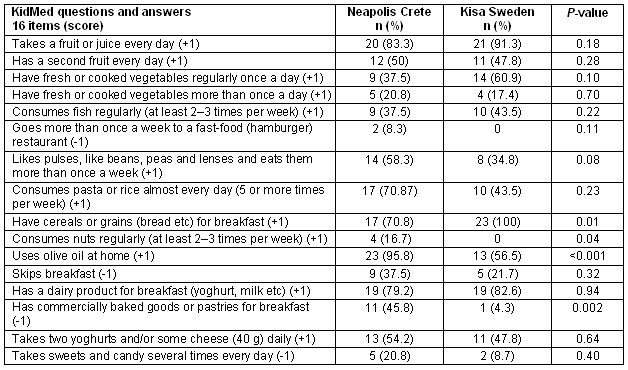
The results of the KidMed questions are presented (Table 1). The p-values were adjusted for age and gender differences between the sites. There was no difference (p = 0.48) in the total KidMed score between Cretan (Neapolis mean = 5.71, 95% CI 4.60-6.82) and Swedish children (Kisa mean = 5.91, 95% CI 5.26-6.56). However, there were some significant differences for certain questions in the KidMed score. The Cretan families reported significantly higher daily use of olive oil at home, commercially baked goods or pastries for breakfast and regular nut consumption, while the Swedish families reported significantly higher use of cereals, grains or bread for breakfast. The mean BMIs were similar for the Cretan (Neapolis mean 16.8, 95% CI 13.5-23.0) and Swedish children (Kisa mean 17.4, 95% CI 13.7-25.5).
Table 1: Comparison of the KidMed (Mediterranean Diet Quality Index in children and adolescents12) questions between children from Crete (village of Neapolis n = 24) and Sweden (village of Kisa n = 23), and the points assigned to each question (data adjusted for age and gender).
Discussion
Our results indicate that the use of a diet characterized as Mediterranean for children less than 13 years of age was quite similar between children from a rural village in Sweden and a rural village on Crete, as judged by the KidMed index. However, two typically Mediterranean diets features, daily use of olive oil at home and regular nut consumption, were significantly more common among the Cretan children. We also found that more children eat sweets and pastries for breakfast on a daily basis in Neapolis village compared with Kisa village. In Sweden, many families have embraced the rule of so-called 'Saturday sweets' with sweets only being allowed on Saturdays. According to these results, this does not seem to be the case on Crete. The nutritional habits revealed in this study among children must be seen against a background of ongoing social changes, even apparent in rural areas, in both countries. In Sweden, there is generally a high level of dietary awareness, and parents tend to adopt parts of the MD, for example an increase in fruit consumption and the use of olive oil, which previously was sold only as a laxative in Swedish pharmacies. Further, in Sweden there are common dining restaurants in schools, available free of charge for all children, where food is prepared in accordance with a balanced diet chart. The Cretan children bring packaged lunches to school. Some Cretan children eat traditional foods, while others have more or less abandoned the traditional diet for a Western diet that includes junk food, which contains a large amount of 'empty calories' (eg pastries). Recent studies have been conducted on Crete with the aim of emphasizing the importance of the MD and other health factors by including such information in the education of Greek children12,13. The results of these intervention studies showed that knowledge of health, nutrient intake and physical activity had increased among participating children, with the potential to reverse negative acquired nutritional habits14,15.
Our study raises the question of whether Cretan children have abandoned some aspects of the traditional MD, even in rural areas. The results indicate a possibility of changing nutritional habits that is measurable among small children in rural areas, because the dietary differences of Swedish children are small in comparison. However, the results must be interpreted with caution due to the small number of participating children, and the fact that there were no base-line measurements for the children. Another limitation is that the parents rather than the children filled in the questionnaire. The study does warrant further studies with larger samples, preferably with children at various ages.
Acknowledgements
The authors acknowledge the support of colleagues and collaborators Dr Foteini Anastasiou, Dr Stergios Kechagias, Dr Roza Chereti, Dr Stella Pagona, Dr Björn Törnqvist. They also thank the participating staff at the primary health care centers in Neapolis, Crete and Kisa, Sweden.
References
1. La Vecchia C. Mediterranean diet and cancer. Public Health and Nutrition 2004; 7: 965-968.
2. Keys A. Coronary heart disease in seven countries. IX. The Greek islands of Crete and Corfu. Circulation 1970; 41(4 Suppl): 188-100.
3. Kannel WB, Dawber TR, Kagan A, Revotskie N, Stokes 3rd J. Factors of risk in the development of coronary heart disease-six year follow-up experience. The Framingham Study. Annals of Internal Medicine 1961; 55: 33-37.
4. Trichopoulou A, Costacou T, Bamia C, Trichopoulos D. Adherence to a Mediterranean diet and survival in a Greek population. New England Journal of Medicine 2003; 348: 2599-2608.
5. Knoops KT, de Groot LC, Kromhout D, Perrin AE, Moreiras-Varela O, Menotti A et al. Mediterranean diet, lifestyle factors, and 10-year mortality in elderly European men and women: the HALE project. JAMA 2004; 292(12): 1433-1439.
6. Yannakoulia M, Karayiannis D, Terzidou M, Kokkevi A, Sidossis LS. Nutrition-related habits of Greek adolescents. European Journal of Clinical Nutrition 2004; 58: 580-586.
1. Kafatos A, Diacatou A, Voukiklaris G, Nikolakakis N, Vlachonikolis J, Kounali D et al. Heart disease risk-factor status and dietary changes in The Cretan population over the past 30 years: the Seven Countries Study. American Journal of Clinical Nutrition 1997; 65: 1882-1886.
8. Laron Z. Increasing incidence of childhood obesity. Pediatric Endocrinology Review 2006; 1(Suppl 3): 443-447.
9. WHO. Young people's health in context. Heath behavior in school-aged children (HBSC-study). International report from the 2001/2002 survey. Copenhagen: WHO Europe, 2004.
10. WHO. The challenge of obesity in the WHO European Region and the strategies for response. Copenhagen: WHO Europe, 2007.
11. Trichopulou A, Lagiou P. Healthy traditional Mediterranean diet; an expression of culture, history and lifestyle. Nutrition Review 1997; 55: 383-389.
12. Serra-Majem L, Ribas L, Ngo J, Ortega R, Alicia Garcı́a A, Pérez-Rodrigo C et al. Food, youth and the Mediterranean diet in Spain. Development of KIDMED - Mediterranean Diet Quality Index in children and adolescents. Public Health and Nutrition 2004; 7: 931-935.
13. Kafatos I, Peponaras A, Linardakis M, Kafatos A. Nutrition education and Mediterranean diet: exploring the teaching process of a school-based nutrition and media education project in Cretan primary schools. Public Health and Nutrition 2004; 7(7): 969-975.
14. Lionis C, Kafatos A, Vlachonikolis J, Vakaki M, Tzortzi M, Petraki A. The effects of a health education intervention program among Cretan adolescents. Preventive Medicine 1991; 20: 685-699.
15. Manios Y, Kafatos A. Health and nutrition education in elementary schools: changes in health knowledge, nutrient intakes and physical activity over a six year period. Public Health and Nutrition 1999; 2(3a): 445-448.