
 download PDF
Introduction
Infertility is a global health issue, affecting approximately 8-10% of couples worldwide1,2. In some societies of Sub-Saharan Africa (known as the 'infertility belt') one-third of all couples are unable to conceive during their reproductive lives3. The 1981 census of India estimated infertility to be in the range of 4-6%4. A global review of infertility from the World Fertility Survey and others estimated similar rates of infertility in other settings in South Asia, such as 4% in Bangladesh, 6% in Nepal, 5% in Pakistan and 4% in Sri Lanka5. One estimate of overall primary and secondary infertility in South Asia, on the basis of women at the end of their reproductive lives in the age group 45-49 years, suggests an infertility rate of approximately 10%: 8% in India, 10% in Pakistan, 11% in Sri Lanka, 12% in Nepal and 15% in Bangladesh6.
Infertility is not merely a health problem, it is also a matter of social injustice and inequality. Tribal populations in India have high levels of morbidity arising from poor nutrition, and coupled with high infant, child and maternal mortality, and they also have low levels of literacy7,8.
In India, there are 427 tribal groups comprising 8% of the total population9. The tribes are isolated, socially undeveloped, economically disadvantaged and mainly confined to hilly and densely forested areas8,9. Madhya Pradesh is situated in the center of India and is known as a rich source of natural resources, cultural heritage and as 'the heart of the country'. It has the largest number of tribal communities (46) constituting 23.3% of the state population10. The Khairwar tribe is a sub-tribe of the Gond tribe and is and mostly confined to the Sidhi and Surguja districts of Madhya Pradesh. The traditional occupation of the Khairwar is 'Kattha' (Catechu), or making objects from Khairwood and this activity gives them their name8. This article focuses on reproductive health problems among infertile women aged 15-49 years in vulnerable tribes in Madhya Pradesh, by exploring the research findings of a fertility study in 2002. The study aimed to investigate the prevalence of infertility among Khairwar and non-Khairwar tribes, and to identify the factors responsible for infertility among infertile couples.
Methods
The study was carried out in six villages of the Kusmi block of the Sidhi district of Madhya Pradesh in April 2002. A total of 1305 people were accessed from 284 households. The sampling unit was a household and sampling frame; 173 households of the Khairwar tribe and 111 households of a non-Khairwar tribe were studied. One hundred and thirty-three eligible couples from the Khairwar tribe and 99 eligible couples from a non-Khairwar tribe were studied. Purposive sampling design was adopted for the study because the tribe is dwindling due to infertility and migration. The Regional Medical Research Center, Jabalpur, Ethics Committee approved the study, and written consent was obtained from study individuals. In the case of illiterates, consent was obtained in the form of thumbing. The contents were explained to them in presence of a witness. All households of the study area were accessed by a house-to-house census. Information on age, sex, marital status, childless women and duration of marital life, children ever born and details of fertility history of the women was collected through a structured interview schedule by trained investigators.
Defining infertility
Lack of uniform definitions has characterised research on infertility. It is accepted that the terms infertility, childlessness or sterility all refer to the incapacity of couples to conceive or bear children when desired. The WHO definition, drawn up by the Scientific Group on the Epidemiology of Infertility has used a two-year reference period11.
Primary infertility: In the present study, infertility was labeled primary if the couple had never conceived despite cohabitation and exposure to the risk of pregnancy (absence of contraception) for a period of 2 years11.
Secondary infertility: In the present study, infertility was labeled as secondary if the couple failed to conceive following a previous pregnancy, despite cohabitation and exposure to the risk of pregnancy (in the absence of contraception, breastfeeding or postpartum amenorrhoea) for a period of 2 years11.
Due to the small study population, primary and secondary infertility have been analysed together.
Results
The prevalence of infertility
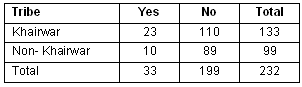
The prevalence of infertility among Khairwars and non-Khairwars in the study area is shown (Table 1). Out of 232 currently married women, approximately 33 (14.2%) of the interviewed couples were classified as infertile. The sex ratio was 1053 (female/1000 male) in the Khairwars and 882/1000 in non-Khairwars. Among the Khairwars, 23 couples (17.2%) were infertile; while 10 (10%) of non-Khairwars couples were infertile. The infertility was significantly higher among Khairwars than non-Khairwars.
Table 1: Distribution of the prevalence of infertility among the studied tribal population
Infertility and wife's age and duration of marriage
The average age of infertile Khairwar women was 31 years and 27 years for non-Khairwar women (p<0.05).
The average age at marriage was 16.3 years for Khairwars and 16.2 years for non-Khairwar women.
The average duration of marriage of infertile Khairwar women was 14.9 years, significantly greater than the mean marriage duration of 11.1 years for infertile non-Khairwar women.
Infertility, education and occupation
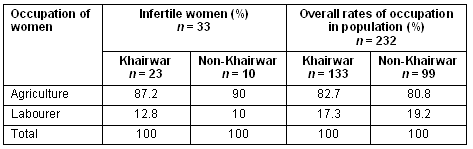
The data in Tables 2 and 3 demonstrate that while infertile women in this region are more likely to be illiterate and employed in agriculture, this merely represents the overall population norms for both Khairwar and non-Khairwar women.
Table 2: Distribution of infertility according to education of women
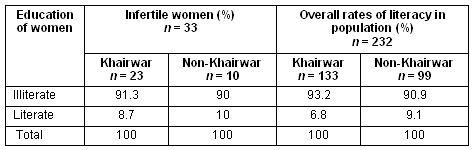
Table 3: Distribution of infertility according to occupation of women
Discussion
The study was undertaken to gain insight into the problem of infertility in the Khairwar tribe. Our study explored the possible association between prevalence of female infertility and some selected socio-economic variables. The observed infertility among Khairwar women was 7.2%, a higher incidence than among non-Khairwar women.
Tribal communities are vulnerable because they are isolated from mainstream resources; and this community does not have easy access to the Indian health delivery system. However the Khairwars do not appear interested in seeking this assistance. Instead, they believe in local traditional healers (gunias).
Childless women are particularly vulnerable in their old age2 in tribal society. Infertility also complicates marital dynamics, sometimes leading to marital instability, and occasionally divorce, polygamy or remarriage. Because motherhood is considered a mandatory status, infertile women may be harassed and tormented. Infertile tribal women suffer most profoundly in their relationship with their in-laws and other community members.
Conclusions
The prevalence of infertility among Khairwars was higher than that among non-Khairwars. Social, cultural and economic factors continue to inhibit tribal women from gaining adequate access to the health delivery system. Further study is needed to determine the causes of tribal infertility and to identify interventions.
Acknowledgements
The author conveys sincere thanks to the Indian Council of Medical Research, New Delhi and the Regional Medical Research Centre for Tribal, Jabalpur for providing necessary facilities and encouragement. He also thanks Dr Jotirmoy Roy, and Dr DC Jain, research assistant, for their participation in the study.
References
1. Reproductive Health Outlook. Infertility: overview/lessons learned. Online (1997-2005). Available: http://www.rho.org (Accessed 6 July 2005).
2. Inhorn MC. Global infertility and the globalization of new reproductive technologies: illustration from Egypt. Social Science and Medicine 2003; 56: 1837-1851.
3. Cates W, Farely TMM, Rowe PJ. Worldwide patterns of infertility: is Africa different? The Lancet 1985; 2 (8455): 596-598.
4. Department of Family Welfare. Ministry of Health and Family Welfare Yearbook 1993-1994. New Delhi: Government of India, 1995.
5. Vaessen M. Childlessness and infecundity. WFS Comparative Studies, Series 31. Voorburg, The Netherlands: Cross National Summaries, 1984.
6. Farely TMM, Baisey EM. The prevalence of a etiology of infertility. Proceedings, African Population Conference. 28 November 1988; Senegal, Dakar; 1998.
7. Tewari DN. Primitive tribes of Madhya Pradesh, Strategy for Development. New Delhi: Tribal Development Division, Ministry of Home Affairs, Government of India, 1984.
8. Regional Medical Research Centre for Tribals. Glimpses of tribal health (1995-96). Jabalpur, Madhya Pradesh: Indian Council of Medical Research, 1996.
9. Russell RV, Hira L. The tribes and caste of the central provinces of India, Vols 3 & 4, 1916. Low Price Publications: Delhi, 1997.
10. WHO, Programme on Maternal and Child Health and Family Planning, Division of Family Health. Infertility: a tabulation of available data on prevalence of primary and secondary. WHO/MCH/91.9. Geneva: WHO, 1991.
11. Kumar D. Tribal literacy disparity in India. Current Science 2005; 88: 676.
Research Note
Prevalence of female infertility and its socio-economic factors in Tribal communities of Central India
AFFILIATIONS
1 Banaras Hindu University, Regional Medical Research Centre for Tribals (ICMR), Jabalpur M P, India
PUBLISHED
8 May 2007 Volume 7 Issue 2
HISTORY
RECEIVED: 17 June 2005
REVISED: 2 November 2005
ACCEPTED: 8 May 2007
CITATION
Kumar D. Prevalence of female infertility and its socio-economic factors in Tribal communities of Central India. Rural and Remote Health 2007; 7: 456. https://doi.org/10.22605/RRH456
AUTHOR CONTRIBUTIONS
© Dinesh Kumar 2007 A licence to publish this material has been given to ARHEN, arhen.org.au
Abstract
Introduction:
The Khairwar tribe of India is dwindling due to infertility and migration. The study investigates an extensive infertility problem among Khairwar and non-Khairwar tribes in the same geographical area. The objective of the study was to determine for the first time the prevalence of infertility in these two tribal groups.Method: The study was carried out in the Kusmi block of the Sidhi district of Madhya Pradesh in Central India. The data were collected by trained investigators through a structured interview scheduled in April 2002. A total of 1305 people were studied from 284 households. Of a population of 778 people, 133 eligible couples belonged to the Khairwar tribe; out of a population of 527 people, 99 eligible couples belonged to non-Khairwar tribes.
Results: The prevalence of infertility of the study population was 33 (14.2%) out of 232 women. In the Khairwars, infertility was found in 23 (17.2%) significantly higher than in non-Khairwars - 10 (10%). The mean age of infertile women among the Khairwars was 31.3 ± 8.9 years and 27.5 ± 9.2 years among non-Khairwars. The average duration of marriage of infertile women in the Khairwars and non-Khairwars was estimated as 14.9 ± 7.7 years and 11.1 ± 7.9 years respectively.
Conclusion: The prevalence of infertility is higher in the Khairwars compared with non-Khairwars. It is suggested that further study needs to determine the causes and necessary interventions.
Key words: India, infertility, socio-economic factors, tribal communities.
You might also be interested in:
2018 - Frontier and Remote Paramedicine Practitioner Models
2007 - Clinical skills day: preparing third year medical students for their rural rotation