

 download PDF
Introduction
Clinical trials in industrialized countries have demonstrated a significant decline in cardiovascular disease morbidity and mortality through intensive treatment of hypertension in diabetic patients. Even though these trials show that treating hypertension is beneficial in reducing hypertension-associated morbidity and mortality, Berlowitz et al1 reported that diabetic patients were receiving less intensive antihypertensive treatment and had a poor level of hypertension control at a threshold blood pressure (BP) of <140/90 mmHg. With regard to Greek patients in rural areas (general population), there were few data about the prevalence, awareness, treatment and control of hypertension2-3. The aim of the VANK study was to determine the prevalence of hypertension and the levels of awareness, treatment and control of hypertension in these diabetic patients.
Methods
The VANK4 study was a multi-center, cross-sectional survey which was carried out in order to determine the prevalence of hypertension and the levels of awareness, treatment and control of hypertension in primary care. The survey included 1507 subjects, 770 men (51.09%) and 737 women (48.9%) who visited the rural Health Centers of Vlachioti (V), Astros (A), Nemea (N) and Kalavrita (K) from 1 January 2001 to 31 March 2001. Primary healthcare physicians (GPs, not junior doctors) in these centers carried out the study. In this analysis, we studied 221 men and women (122/99) patients with type 2 diabetes (prevalence of diabetes 14.6%). Diabetes mellitus (DM) was self-reported and defined as current use of antidiabetic treatment.
Semi-structured interviews were conducted with all participants. The study protocol was reviewed by a bioethical committee but no written consent was obtained from participants because an anonymous questionnaire was used.
Data collected included demographic characteristics, history of hypertension, smoking habits, alcohol intake, antihypertensive medications, other drug treatment and self-reported chronic medical conditions. The interview included more specific information related to diagnosis (if, when and how BP was measured) and treatment of hypertension. Blood pressure was measured using a standard mercury sphygmomanometer with an appropriate cuff size. Three sitting BP measurements were taken from each subject, 5 min after rest and 30 min after smoking, on the patient's left arm, with a two-minute interval between them. Average systolic and diastolic BPs were calculated for each subject. Participants with elevated BP measurements were invited to a second clinic visit after 7-14 days to have their BP re-measured. The average BP on the second visit was used as criterion for the diagnosis and control of hypertension. Hypertension for diabetic patients in our survey was defined using the 'Sixth Report of the Joint National Committee on the Detection, Evaluation, and Treatment of High Blood Pressure' (JNC VI)5 (systolic BP ≥130 mmHg and/or diastolic BP ≥85 mmHg or current treatment with an antihypertensive drug). Treated hypertension was defined as the current use of antihypertensive medication as determined by review of all medications taken. The controlled hypertension definition was based on systolic BP <130 mmHg and diastolic BP <85 mmHg in subjects taking antihypertensive medications.
Statistical analysis
Data are expressed as mean ± standard deviation (SD). Student's t-tests and one-way analysis of variance (ANOVA) were used for intra-group and inter-group comparisons of continuous variables. Bonferroni's correction for multiple comparisons was applied, where appropriate. Pearson's χ2 test was used to compare between-groups differences. Logistic regression analysis with a backward stepwise approach was employed to identify variables associated with hypertension. Relative risks (RR) were calculated from logistic regression models. Any p value <0.05 (two-tailed) was considered statistically significant. Data were analyzed using SPSS v 11.5 (SPSS, Chicago, IL, USA).
Results
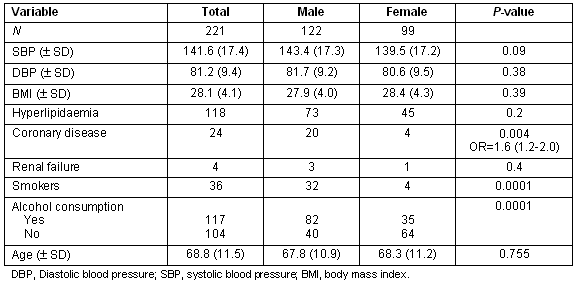
The mean age ± SD of the sample was 68.8 ± 11.5 years and there was no statistically significant difference between men and women (67.8 ± 10.9 vs 68.3 ± 11.2, p = 0,7). The mean duration of diabetes ± SD was 12.4 ± 6.7 years. The mean ± SD value of BP was 141.6 ± 17.4 mmHg and 81.2 ± 9.4 mmHg for systolic and diastolic BP, respectively. Systolic and diastolic BP was higher in men than in women (Table 1). The overall prevalence of hypertension was 194/221 (87.7%). No significant differences were found in prevalence rates among men and women.
Table 1: Demographic characteristics and risk factors
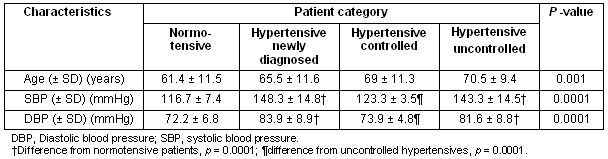
In total, 34.1% (66/194) of hypertensive patients were not aware of having hypertension. Of those who were aware (n = 128, 65.9%), all were treated. Among treated hypertensives, only 11 persons (11/194, 5.6%) had systolic BP <130 mmHg and diastolic BP <85 mmHg. Sixty-two (38.7%) had systolic BP <140 mmHg and diastolic BP <90 mmHg. Table 2 shows the characteristics of subgroups classified by treatment and control status.
Using a logistic regression analysis we examined variables including sex, age, family history, smoking status, hyperlipidaemia, coronary heart disease, body mass index and alcohol intake for their potential to predict hypertension. Variables associated with hypertension were age (Wald = 12.6, p = 0.0004), history of coronary heart disease (Wald = 6.5, p = 0.01, RR = 6.4 95% CI: 1.5-26.6) and family history of hypertension (Wald = 10.6, p = 0.001, RR = 2.9 95% CI: 1.5-5.6).
Table 2: Differences in characteristics per category of patients
Discussion
This cross-sectional study provides data on prevalence, treatment, awareness and control of hypertension among a diabetic Greek population living in four different rural areas with similar socioeconomic characteristics.
Although all of the diagnosed hypertensive patients (n = 128) received antihypertensive drug therapy, in only 8.6% (11/128) was the treatment effective (BP <130/85 mmHg). However, low rates of hypertension control in diabetic patients have been reported even from clinics specializing in hypertension treatment. In one study6, the proportion of patients with diabetes who have controlled BP (130/85 mmHg) was 22%; while in another multicenter study7 only 26.7% met the treatment goals.
In the VANK study4 the rate of control in treated hypertensives was 55% (39.4% in total), reflecting an increased awareness among Greek primary care physicians regarding the importance of treating hypertension. In diabetic patients, even though the overall rate of control using the threshold of <140/90 mmHg could be considered high, our study showed that primary care physicians in Greece are not aware of published guidelines for treating hypertension in diabetic patients, and thus manage them as if they were patients with uncomplicated hypertension.
Our study has some potential limitations. First, the study population included relatively older persons than the total Greek population, especially when compared with urban areas. Second, the proportion of alcohol consumers was very high compared with urban populations, a phenomenon that has been observed in other Greek studies8. Consequently, the true prevalence rate of hypertension in the diabetic population may be somewhat lower and the level of control somewhat higher.
However, when translating our findings into clinical practice, there is a need for aggressive treatment of hypertension by primary care physicians. Regular surveillance to detect developing hypertension in diabetic patients and provision of related continuing education programs to health care professionals are clearly needed.
Acknowledgement
The study was presented in poster form at the 40th Annual Meeting of the European Association for the Study of Diabetes, 5-9 September 2004, Munich, Germany.
References
1. Berlowitz DR, Ash AS, Hickey EC, Glickman M, Friedman R, Kader B. Hypertension management in patients with diabetes: the need for more aggressive therapy. Diabetes Care 2003; 26: 355-359.
2. Stergiou GS, Thomopoulou GC, Skeva II, Mountokalakis TD. Prevalence, awareness, treatment and control of hypertension in Greece. The Didima study. American Journal of Hypertension 1999; 12: 959-965.
3. Skliros E, Papaioannou I, Sotiropoulos A, Giannakaki G, Milingou M, Lionis C. A high level of awareness but a poor control of hypertension among elderly Greeks. The Nemea study in primary care. Journal of Human Hypertension 2002; 16: 285-287.
4. Skliros E, Vasibossis A, Loumakis P, Sotiropoulos A, Giannakaki G, Razis N. Evaluation of hypertension control in Greek primary care units. The V.A.N.K study. Journal of Human Hypertension 2003; 17: 297-298.
5. Joint National Committee on Detection, Evaluation and Treatment of High Blood Pressure. The sixth report of the Joint National Committee on the Detection, Evaluation, and Treatment of High Blood Pressure (JNC VI). Archives of Internal Medicine 1997; 24: 2413-2446.
6. Singer GM, Izhar M, Black JR. Guidelines for hypertension: Are quality assurance measures on target? Hypertension 2004; 43: 198-202.
7. McFarlane IS, Jacober JS, Winer N, Kaur J, Castro PJ, Wui AM et al. Control of cardiovascular risk factors in patients with diabetes and hypertension at urban academic medical centers. Diabetes Care 2002; 25: 718-723.
8. Lindholm LH, Koutis AD, Lionis CD, Vlachonicolis IG, Isacsson A, Fioretos M. Risk factors for ischaemic heart disease in a Greek population. A cross sectional study of men and women living in the village of Spili in Crete. European Heart Journal 1992; 13: 291-298.