

 download PDF
Introduction
Rural healthcare is becoming a core feature in the undergraduate curricula of the Faculty of Health Science at the University of Tasmania, Australia. Tasmania, like the rest of the world, has a shortage of health professionals working in rural and remote areas. Because nurses represent the largest discipline in the health workforce1, the shortfalls have a devastating impact on rural and remote communities2. The past decade has been characterised by some notable initiatives that are designed to address the maldistributed health workforce3. At the undergraduate level various incentives are resulting in increased emphasis on rural practice in pre-qualifying health science education. In terms of the rural undergraduate program, the Tasmanian School of Nursing does not receive the same level of support as the Schools of Medicine and Pharmacy. Consequently, the University Department of Rural Health in Tasmania provides some monetary support to assist with providing nursing students with rural practice experience.
Providing undergraduate students with rural clinical exposure is consistently reported as a strategy for dealing with the rural workforce shortage4-9. Evidence to support this assertion is still emerging. While the majority of studies report an intention to take up a rural post after graduation and few actually measure behavioural outcomes2, there is a sense that well-supported rural placements can have a positive effect on students' commitment to rural practice10. Nursing students regard experiential clinical learning opportunities as crucial experience for advancing their professional and clinical knowledge11. Because most undergraduate students enrolled in undergraduate health science programs do not have a rural background, they view rural clinical practice from an uninformed position. When faced with decisions about where they may want to undertake clinical practice, they may regard the prospect of a rural placement as being disadvantageous to their professional development. Strasser reports that, from an undergraduate viewpoint, the advantages of rural placements may be outweighed by the perceived disadvantages12.
There is a risk that undergraduate nursing students may regard rural placements as a waste of time. During experiential clinical practice nursing students classify the major categories of learning as nursing skills, time management and professional socialisation11. This article will present one of the themes that was developed in an ethnographic hermeneutic study that explored the experiences of undergraduate student nurse first engagements with rural clinical practice. It presents how the nursing students initially expected to spend their time caring for people, but realised they first needed to spend their time learning about rural nursing before they could do the work of rural nursing. The findings indicate that rural placements are rich learning environments where undergraduate nursing students can advance their nursing skills, time management and professional socialisation in a positive and productive way.
Background
The Faculty of Health Science at the University of Tasmania is now focussed on rural issues as an important component of both its teaching and research programs. Students completing the pre-registration Bachelor of Nursing degree, engage in a year-long unit known as 'Supportive Care in Hospital and Community Settings'. The unit aims to build on the first year introductory units that focus on primary healthcare and health promotion, by shifting the emphasis to nursing in community and clinical environments. All Tasmanian School of Nursing units are developed using the ANCI Competency Standards for the Registered Nurse. The current ANCI competency domains for registered nurses are Professional and Ethical Practice; Critical Thinking and Analysis; Management of Care; and Enabling13.
The students who participated in the present study undertook their rural placement at the North Eastern Soldiers Memorial Hospital (NESM), Dorset, Tasmania, which is the sole provider of acute healthcare for the Dorset municipality. The diverse hospital services provided to the community are supported by a variety of healthcare professionals and visiting specialists. As a hub for rural healthcare services in the Dorset region, this is an ideal place for students to understand and be involved in the comprehensive nature of rural healthcare. During the rural placement, students are provided with direct supervision from registered nurses, and ongoing support from nurse academics. During the 2 week placement the students live at a Rural Health Teaching Site (RHTS), which is one of the University Department of Rural Health's network of learning environments dedicated to rural health teaching, learning and research. Located adjacent to the hospital, the RHTS provided students with accommodation and information technology facilities.
Methods
The study drew on ethnographic methods articulated by Geertz14 and hermeneutic philosophy espoused by Gadamer15. Approached as a research partnership between the researcher and participants, the ethnographic methods involved confidential interviews, participant observation, and field notes. In approaching social action as a text, the ethnographic methods facilitated the building of ethnographic descriptions of the students' engagement with rural practice. These narratives were contextualised within a complex background of historically established rural cultural meanings and belief systems. The nursing students imposed meaningful historical order on to these events, and selectively highlighted particular parts of these experiences in their narratives.
Hermeneutic philosophy was used to interpret the way the students selectively narrated parts of their experience and incorporated various cultural meanings into their broader life. Interpretation was achieved by examining the parts of the students' experience against the whole, using the key philosophical constructs of hermeneutic philosophy: the hermeneutic circle, dialogue and the fusion of horizons as metaphors16. Additionally, the researcher maintained a reflective journal to log developing insights that were continually mediated against students' understandings. The importance of Gadamer's15 contribution to the present study was the attention to detail in the research process, particularly in relation to representation, in terms of rigour and legitimation, in terms of both the students', and researcher's, voice.
Results
Four main themes emerged in relation to the way students conceptualised time during clinical practice in the rural setting. The students entered the practice arena expecting to spend their time caring for people; however they quickly came to spend their time learning about nursing. In reality the students spent a large proportion of time doing nursing work. Consequently time became a source of conflict for the nursing students. These meanings have been diagrammatically represented (Fig 1), which also forms the conceptual grid on which this paper is structured.
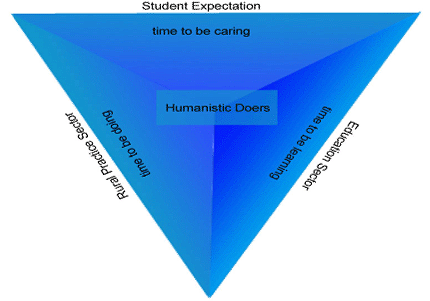
Figure 1: Student conceptions of time in the rural context.
Time to be caring
The nursing students entered the world of rural practice with the belief that nursing involves spending time closely involved with patients, in order to provide high quality care. One student described her belief that a nurse is:
someone who always knew what they were doing ... has to be responsible for the care of the patient ... not just physically but also emotionally like emotionally they are the main caregivers because with doctors you don't often see ... yeah they get emotionally attached to patients. Yeah ... someone ... someone who is professional but also ... human.
The students believed caring for patients was integral to the role of the nurse, and was therefore considered a meaningful way to occupy nursing practice time. The patients positively reinforced this belief when the students spent vast amounts of time just being with them, usually talking to them. A student's experience with a patient who was unable to communicate demonstrated this:
I know he appreciates me just being there talking with him ... I don't have to be doing anything in particular to him ... or with him ... just sitting there ... maybe holding his hand ... I tell him how I am going on prac ... what my plans for the weekend are ... simple things ... I can tell he likes it by the appreciation in his eyes ... I can just tell
.
Despite using time in this way, the nursing students quickly appreciated that this level of involvement in nursing practice was insufficient to meet all of the patients' needs at a high standard. Like the participants in Fagerberg and Kihlgren's17 study, the students realised their 'love and attention' was insufficient to provide appropriate nursing care to the patients. They realised that 'caring' was not a naturally occurring ability, and that they did not yet have sufficient knowledge to provide the patients with the sort of nursing care they originally aspired to provide. This conscious awareness was the impetus for the students to actively pursue learning opportunities, such as how to perform hygiene needs and distribute medications safely, in order to engage in the profession at a higher level.
Time to be learning
In wanting to care and to be with patients, yet not knowing how to implement this care, the students recognised a dichotomy between their desire and their ability. This realisation led the students to alter the way they used their time. Their purpose shifted from wanting to care for patients, to wanting to learn and understand what nursing involves, and how they could go about it. The students who participated in the study were undertaking 3 weeks' clinical practice as an extension of a theoretical unit at university. Hence, the transformation in the way students used their time to learn, was further enhanced through the University expectation that students would complete the necessary written components for the formative assessment. To facilitate learning the students to began to listen, observe and take notes.
The tension surrounding written practices other than nursing documentation in the clinical environment is discussed by Street18. She suggests that, as clinicians, nurses consider their priority falls in providing nursing care to patients, and as such regard the practice of writing as an inappropriate use of time18. In nursing, time is a precious commodity and should not be wasted on meaningless activity such as writing, rather it should be used carefully in order to get the work of nursing done. The nursing students became aware of this cultural rule and therefore soon abandoned their notebooks. It was clear to the students that learning had to be achieved through less obvious mechanisms. As a result, the students adopted a less visible, yet highly successful means of using their time to learn. One student achieved this through a process of observation and surveillance when she:
... stands at the door as her eyes to scan the room of chattering nurses ... cautiously she steps into the room to stand against the back wall to silently watch the buzzing nurses ... her eyes fleet about as she sights every action and exchange the nurses make ...her eyes peer over the perimeter of her mug to still watch the nurses as she sips at her drink.
Learning through observation is a powerful means of transmitting patterns of thought and behaviour19, and the students regarded it as an effective way to use time. As observers, the students were engaged in a cognitive activity that allowed them to internalise the behaviour they saw. On the basis of repeated demonstrations by the rural nurses, the students developed a mental blueprint of certain behaviours and tasks. The repeated viewings enabled them to enhance the cultural blueprint through a process of comparison, in which they extracted the common rules relating to the performance.
The students quickly recognised the imperative to get a lot of work done. They were very critical of the nursing activities they were observing at this time. The criticisms stemmed from the experience of reality conflicting with their preconceived images of nurses as angelic carers. One student stated:
... I hate the way some nurses treat the patients like chunks of meat ... they just go and do what they have to do to them with little regard for what the patient wants or whether they even want it for that matter ... I hate it ... it makes me really angry.
Despite being opposed to the way the nurses approached their nursing practice, they had no other frame of reference for working out what needed to be done, or how they should go about it. Consequently, they developed a cultural blueprint on the basis of the routines and rituals, such as hygiene and medication rounds, because they believed they had little choice other than to base their learning on the actions that were being performed.
Time to be doing
The production of the perceptual blueprint through observation, enabled the students to identify that getting the work done was a key priority for the nurses in this context. They identified that within each of the shift divisions certain nursing tasks were routinely performed each day, and they recognised that these tasks were coordinated with specific times:
Sophie looks up to the clock and also sighs saying 'sixteen hundred ... nearly time for the round'. The nurse turns and peeks at the clock and says 'yep ... nearly time' and they proceed to sit and watch the clock tick by its last few minutes until four o'clock. As soon as the large hand of the clock strikes the number twelve the nurse and Sophie stand in unison and make their way to the doorway of the nurses office.
This excerpt demonstrates how the students used time as a social structure. As a uniformly imposed framework for all social activities, time became an organising feature of social life20. However, at this agency time was also understood in terms of how it should be appropriately used. While tolerant of the students' learning needs, there was a general expectation within the rural practice sector that the students would gradually increase their patient load. It was expected that students would be taking a 1-2 patient load, and that they would be making some nursing practice decisions within the three-week time frame. The students quickly became conscious of the different agendas, in relation to use of time, between the education and practice sectors. The benefit of using their time to learn began to have application at this stage of the students' professional development.
The second benefit of developing a perceptual blueprint was that the students were able to approximate the tasks to guide their initial attempts of becoming involved in the activity of doing nursing:
... it only took a couple of days of watching the nurses doing their work before I could see that there were certain routines ... like changing all sheets on Tuesdays ...to be done and I just started doing them.
Despite heralding caring and learning as meaningful aspects of nursing practice, the students also realised there was a considerable amount of other nursing work that has to be completed within tight time frames. They realised that nursing encompasses many tasks that do not always involve the patient, such as coordination of additional services, administrative work, inter-professional liaison, and general duties such as stock control. After a short time in clinical practice, one student highlighted how her perception of using time in nursing had changed:
... it's a lot more involved than I thought ... because I had never been in a nursing situation before ... I had only heard stories ... I think it's more physical than I thought ... especially in the Mary Blest Wing ... with all the lifting and that running around doing all the extra things like organising linen and stuff.
'Doing nursing' therefore came to have significant meaning for the nursing students, and the amount of work that was to be done within each shift shocked them. At this point in time the nursing students became less critical of the ways nursing practice was being implemented, citing the need to get the work done as an acceptable rationale. When critically discussing the manner in which an elderly lady's hygiene had been approached, one of the students argued against the way the lady was washed despite her pleas to be left alone:
... it's not that they don't prioritise but they just do it all to get it all done ... and I suppose with time constraints too and staffing and things ... you just have to ...
In this context, the student demonstrated her willingness to accept the ideal of the practice sector, the emphasis being on 'getting the job done'. Street discusses at length the 'doing-thinking' dichotomy that exists within the health-service sector21. The student regarded the ideal of service as more highly valued by nurses than the development of knowledge, or understanding the rationale for implementing certain nursing practice21, which gives rise to nursing being approached as ritualistic patterns with little thought.
The students now considered the routine approaches to nursing care as an effective mechanism for managing their time. As a primary motive for implementing various aspects of nursing care, time then became an important commodity for the students within the rural practice sector. They came to attach meaning to the importance of managing time well and not wasting time. To be seen as continuously busy and to meet the obligations of the rural practice sector, the students found themselves steadily increasing the amount of nursing work they did. Caught between the demands of the education and practice agendas, the students came to regard their learning needs as secondary to fulfilling the service needs of the organisation. This is not an unusual occurrence. Holland22 identified an ill-defined transition for the student nurse, and asserted the lack of clarity was perpetuated for students by their dual role as both student nurse and worker. Alison's behaviour, while emptying the linen trolleys, illustrated this very tension when a nurse announced one of the patients had not yet had her insulin:
... dragging the linen trolley Alison stops as the nurse asks 'you wanna do it' ... and her face lights up and she smiles broadly as she nods eagerly before she looks back at the trolley and says 'oh but I haven't emptied the linen yet' ... the student says quickly 'oh leave that ... don't worry I will fix it for you' before Alison asks 'oh are you sure?'
This student learned that it was culturally unacceptable to leave nursing work incomplete. Her understanding and compliance to this tacit rule was so allegiant that she questioned the suitability of abandoning the linen bin in preference to seizing a learning opportunity. The students believed the ability to carry out certain practical skills without direction or guidance was valued by the nursing staff. They believed this also made it possible for them to 'fit' into the practice area22. Indeed, initiation into the craft of nursing by the 'masters' of the craft23 positively rewarded this conformity. At this juncture in their journey, the students were forced to alter their conceptions of nursing when they recognised the dichotomy between the idealistic notion of nurses as carers, and the realistic notion of nurses as doers. In order to meet the obligations and expectations of the education and practice sector while maintaining their own ideals about nursing, the students forced themselves to become humanistic doers whereby they strove to overlay the doing of nursing work with a caring, humanistic approach to patients.
Time to be a humanistic doer
The students' new conception of nursing highlighted a shift in the way they attached meaning to appropriate ways for using time in this context. While they acknowledged that significant amounts of time within their shift involved doing nursing tasks, they were adamant that their time should also incorporate elements of caring. A student summarised this concisely:
... it's two sort of different roles but you have really got to and mesh them together... but not stuff it up ... like you can't go in and say okay I need to give you a suppository Mr such and such, roll over, stick your fingers up his bum and walk straight out ... you can't just be rigid like that ... there are the two ... the emotional side and the mechanical side ... but not to try and mesh them together would be a huge mistake or a huge fault in someone's nursing practice.
Using time in this way effectively enabled the nursing students to fulfil the commitments of both sectors, in order to succeed in each area. This shift in the use of time demonstrates the nursing students' acknowledgement that doing work is important, but also having the patient in focus as the dominant perspective is also important. The students realised that the rural nurse-patient relationship did have a deeper level and was based on intimate understandings. The nursing students came to understand this abstract practice component as 'being there' for patients24 in order to meet their needs and be committed to them. According to Gadow25, such commitment demonstrates the enhancement and protection of human dignity, and this is what the nursing students aimed to achieve.
The students believed the intimate understandings between rural nurses and their patients were largely due to the nature of the small rural community. For example, the students became aware of the local knowledge that was continually exchanged between community members. The students initially took the relationship between the general rural community and the rural clinical environment for granted, as evidenced one evening shift while they were reading the death register. Sophie:
... points at one of the journal entries and says 'look ... that's that lady who just died' ...the other student replies 'she is the lady that that lady was talking about in the street ... don't you remember ... when I was carrying the flowers back to the nurses home for Kim and she stopped me and asked me if I was going to the funeral ... you remember I had to help her across the road and she told me that this lady had died ten days ago and the funeral was a bit slow coming.
Before long, however, the students realised this information exchange privileged both nurses and patients before they entered the nurse-patient relationship. They believed the mutual exchange of information by community members was supported by the intimate infrastructure that underpinned this rural community. As such, the students realised that people in the clinical environment could not be considered in isolation from the rural community, because they formed part of its comprehensive network. Alison:
... because it is a country town it is all so intimate and everybody knows each other ... you have got to be careful that you don't say in front of a patient 'Oh I have just been with such and such and they are not too well', because they may well know or even be related to that person.
As the students increasingly engaged with the rural community, they used their understandings of rural community life to inform their approach to rural practice. As humanistic doers, the nursing students focused on the individual nature of the patient, while recognising the intimate framework of the rural community, to meet their obligations for doing the work of nursing. Consequently, the nursing students drew from an altruistic framework26 for what they did, by recognising the needs and desires of the patients as a priority over completing the organisational tasks. Being humanistic doers allowed the nursing students to complete the work being done in the wards, and to ensure the patients received the care they required while being treated in a caring manner.
Discussion
Universities are responsible for preparing graduates with professional skills and minimum competence through the development of broad generic skills and grounding in academic learning and systems of knowledge27. Nursing students regard clinical practice as time for advancing their nursing skills, time management and professional socialisation11 to work towards achieving beginning level competence. Rural placements for undergraduate nursing students in Tasmania are voluntary, and students who do not have contextualised understandings of rural culture may regard a rural placement as a waste of time, instead preferring to undertake clinical practice in a larger urban healthcare agency. The present study findings provide evidence that clinical practice undertaken in the rural environment provides optimal learning opportunities for students to advance their clinical knowledge and skills, while also developing their professional identity, as they are socialised into the culture of rural nursing.
Despite their novice status, the students entered their first clinical experience believing they could immediately spend their time caring for people. They quickly realised they did not know how to go about this activity. In order to do the work of rural nursing, the students realised they needed to spend time learning about nursing. They initially achieved this by listening, observing and taking notes, which they soon abandoned in favour of participating in the work of nursing.
Nursing students undertaking rural clinical placements are under pressure from the education sector and the rural practice sector, both of which have competing agendas in terms of time. The tension associated with being 'caught' trying to satisfy the university's educational learning objectives underpinning the clinical placement, while also meeting the rural practice service agenda, were compounded by the additional expectations from the students themselves. The nursing students recognised that getting the work done was the agenda of the practice sector; therefore, they came to attach meaning to time in terms of being a doer. Although critical of task-orientated approaches to nursing practice, they began to 'do the work' of nursing by using time as a frame of reference to complete a series of nursing tasks. Yet approaching nursing care in this way clashed with the students' original altruistic constructs of nursing as a caring profession.
As a result of living in the rural community, the students began to realise that each engagement with local people was informing the way they thought about clinical practice. They recognised the rural nurse-patient relationship extended beyond tasks, routines and rituals to a deep level that was based on intimate understandings. The students attributed the intimacy of these understandings to the nature of the small rural community. Consequently, they came to understand this abstract construct as 'being there' for patients, and they adjusted their professional practice style to use their time to provide humanistic care, rather than just doing the work of nursing.
Conclusion
Until schools of nursing and students of nursing are provided with the same level of incentive as medicine and pharmacy to undertake rural placements, other forms of enticement are necessary. Despite recent drives to recruit students with rural backgrounds into health science courses, the majority have an urban origin. Without rural exposure, many undergraduate nursing students may never even consider the prospect of rural practice while making career choices. Rural placements are consistently suggested as a strategy for raising awareness about rural practice. It is hoped that graduates who were exposed to rural practice as undergraduates, will return to these areas to work.
Career decisions are a long-term concern to students. The short-term concern of students relates to surviving their undergraduate years, while learning to become competent professionals in their field. The findings of the present study have shed some light on the many ways nursing students worked toward developing competence in terms of attitude, knowledge, and skills during the course of a short-term rural placement. It concludes with the argument that clinical practice time in a rural community effectively meets students' immediate learning needs, while raising awareness and the profile of rural practice as a legitimate career option.
References
1. Strong K, Trickett P, Titulaer I Bhatia, K. Health in rural and remote Australia; The first report of the Australian Institute of Health and Welfare on rural health. Canberra, ACT: Australian Institute of Health and Welfare, 1998.
2. Neill J, Taylor K. Undergraduate Nursing Students' Clinical Experiences in Rural and Remote Areas: Recruitment Implications. Australian Journal of Rural Health 2002; 10: 239-246.
3. Prideaux D, Saunders N, Schofield K et al. Country Report. Australia Medical Education 2001; 35: 495-504.
4. Hays R, Price D, Jelbart M, Saltman D. Ruralising the undergraduate medical curriculum through consultation with key stakeholders. Australian Journal of Rural Health 1996; 4: 43-47.
5. Kamien M. A comparison of medical student experiences in rural specialty and metropolitan teaching hospital practice. Australian Journal of Rural Health 1996; 4: 151-158.
6. Barney T, Russell M, Clarke M. Evaluation of the provision of fieldwork training through a rural student unit. Australian Journal of Rural Health 1998; 6: 202-207.
7. McAllistair L, McEwen E, Williams V, Frost N. Rural attachments for students in the health professions: Are they worthwhile? Australian Journal of Rural Health 1998; 6: 194-201.
8. Hays R, Piterman L. Education and training for General Practitioners. General Practice in Australia. Canberra, ACT: Commonwealth Department of Health and Ageing, Commonwealth of Australia, 2000.
9. Peach H, Bath N. Comparison of rural and nonrural students undertaking a voluntary rural placement in the early years of a medical course. Medical Education 2000; 34: 231-33.
10. Smith S, Edwards H, Courtney M, Finlayson K. Factors influencing student nurses in their choice of a rural clinical placement site. Rural and Remote Health 1, 89. (Online), 2001. Available from: http://rrh.org.au/journal/article/89 (Accessed 25 March 2004).
11. Windsor A. Nursing students' perceptions of clinical experience. Journal of Nursing Education 1987; 26: 150-154.
12. Strasser R. Rural general practice in Victoria. The report from a study of attitudes of victorian general practitioners to country practice and training. Melbourne, VIC: Melbourne Department of Community Medicine, The University of Medicine, 1992.
13. ANCI. National Competency Standards for the Registered Nurse, 3rd edn. Canberra: ANCI, 2000.
14. Geertz C. The Interpretation of Culture, 2nd edn. London: Fontana Press, 1993.
15. Gadamer HG. Truth and Method. 2nd revised edn. London: Sheed Ward , 1994.
16. Koch T. Implementation of a hermeneutic inquiry in nursing: philosophy, rigour and representation. Journal of Advanced Nursing 1996; 24: 174-184.
17. Fagerberg I, Kihlgren M. Experiencing a nurse identity: the meaning of identity to Swedish registered nurses 2 years after graduation. Journal of Advanced Nursing 2001; 34: 137-45.
18. Street A. Cultural practices in nursing. Geelong, VIC: Deakin University Press, 1992.
19. Bandura A. Social foundations of thought and action: a social cognitive theory. Englewood Cliffs: Prentice-Hall, 1986.
20. Deakin J, Proteau L. The role of scheduling in learning through observation. Journal of Motor Behaviour 2000; 32: 268-278.
21. Street A. Inside nursing: a critical ethnography of clinical nursing practice. New York, NY: State University of New York, 1992.
22. Holland K. A journey to becoming: the student nurse in transition. Journal of Advanced Nursing, 2001; 29: 229-236.
23. Jacka K, Lewin D. The clinical learning of student nurses. London: Kings College, University of London, 1987.
24. Gilje F. Being there: an analysis of the concept of presence. In: D Gaunt (Ed.). The presence of caring in nursing. New York, NY: National League for Nursing, 1993.
25. Gadow S. Nurse and patient: the caring relationship. In: A Bishop, J Scudder (Eds). Caring, curing coping - nurse, physician, patient relationships. Alabama: The University of Alabama Press, 1985.
26. Gormley K. Altruism: a framework for caring and providing care. International Journal of Nursing Studies 1996; 33: 581-88.
27. Edwards H, Chapman H, Nash R. Evaluating student learning: an Australian case study. Nursing and Health Sciences 2001; 3: 197-205.