



 download PDF
Context
An indwelling urinary catheter forms part of the bundle of care in patients who are critically ill, especially patients who are being medically retrieved between different hospitals. Where urethral catheterisation is not possible, suprapubic catheterisation is required. Access to formal kits for this procedure may be limited in rural, remote and retrieval settings. This report describes a useful alternative technique.
A previously well man aged 52 years was taken to a rural emergency department following an out-of-hospital ventricular fibrillation cardiac arrest, with the return of spontaneous circulation following advanced life support. At the time of his cardiac arrest, he was riding his bicycle and had a low-impact fall. He was intubated soon after arrival at the emergency department of a rural hospital in South Australia by local rural teams due to being agitated and having a compromised airway, and to facilitate imaging. No major internal or traumatic injuries were identified; however, an enlarged bladder was noted on his CT scan. His heart rate and blood pressure were within normal limits, with no ionotropic support. His initial ECG showed ST depression in the inferior leads, hence he was administered anti-ischaemic therapy (aspirin, clopidogrel and therapeutic enoxaparin).
Before the arrival of the retrieval team, experienced local clinicians had three attempts at an indwelling catheter insertion and were unable to pass the prostatic urethra. There was no known history of prostatic enlargement. There was bleeding from the urethral meatus, with no further attempts via the urethral route, given the risk of further bleeding following therapeutic anticoagulation.
The estimated combined travel time from the rural hospital to the destination tertiary facility was 135 minutes. The estimated arrival time was after-hours, whereby limited surgical services would be available onsite immediately. It was anticipated that bladder distension would increase, potentially leading to a pain stimulus and haemodynamic instability. A decision was made to proceed with a suprapubic catheter insertion.
Neither a formal suprapubic catheter kit, a urethral cystoscope or guidewire was available at the rural site, nor was one carried by the retrieval team. However, a pigtail pleural drainage catheter (Cook Medical, 10.2 Fr, 15 cm) was an alternative in offering a minimally traumatic approach to bladder decompression and carried as part of the routine retrieval kit. An ultrasound was first performed to estimate the approximate insertion depth, the bladder's overall size and ensure fenestrations of the catheter would be inside the bladder following decompression. With strict sterile precautions, the catheter was inserted using a Seldinger technique and secured with a suture around the base, a mesentery transparent dressing and surrounding adhesive dressing, and joined to a urine collecting bag using a lighthouse connector (Fig1).
Seven hundred millilitres of urine were immediately drained via the pigtail catheter, with an ongoing output rate of 200 mL/h during retrieval. The patient remained stable from a cardiorespiratory perspective. His suprapubic catheter remained in situ for 4 days following insertion, under advice and close monitoring from the inpatient urology team, with no complications reported (ie urine extravasation, infection, obstruction, bleeding or malposition). His renal function was normal. He was diagnosed with severe triple vessel coronary disease and complete occlusion of his left circumflex artery, requiring a triple coronary artery bypass graft.
The patient recovered and remained neurologically intact. His catheter was removed prior to discharge, and he successfully passed a trial of void. He had ongoing outpatient urology follow-up due to suspected trauma of his penile urethra with two possible causes including the initial fall off his bicycle at the time of his cardiac arrest, and initial attempts at urethral catheterisation.
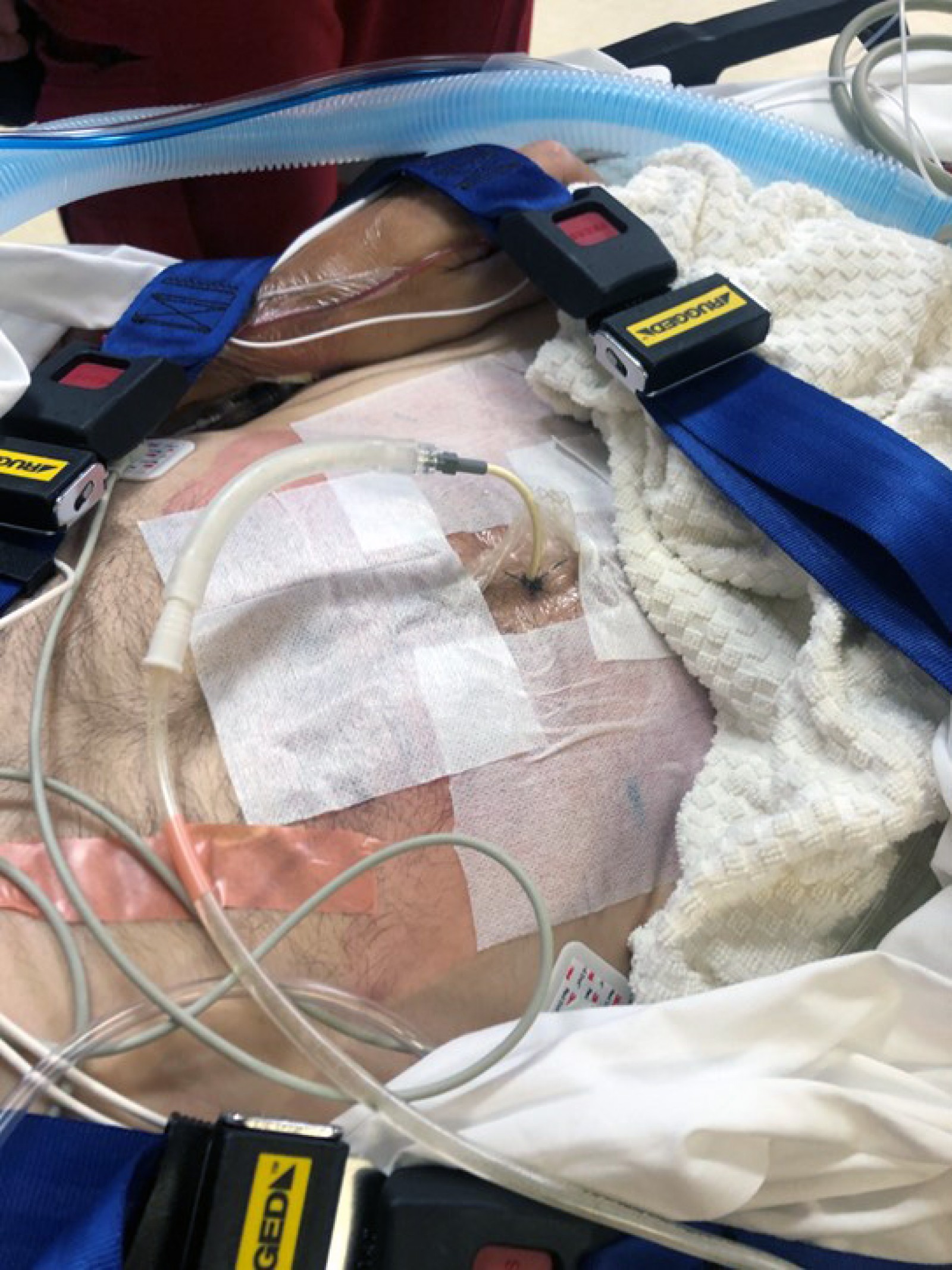 Figure 1: Pigtail pleural drainage catheter connected to lighthouse connector and drainage bag. Secured with suture at base, transparent mesentery dressing, surrounding adhesive dressing and mesentery tape on drainage bag as an additional fixation point for transport.
Issues
Insertion of a urinary catheter is a common procedure in critically ill patients. In addition to providing a marker for end-organ perfusion1, catheterisation prevents a potentially painful stimulus from bladder distension/retention that can result in haemodynamic instability, including in anaesthetised patients2.
While insertion of a urinary indwelling catheter via the urethral route is a very common procedure in the retrieval and rural setting, a suprapubic catheter is not. The decision to proceed with this procedure or defer it until arrival at a destination centre requires a consideration of risks and benefits, including the predicted clinical course and anticipated travel time.
In hospital settings, options for a failed indwelling urethral catheter include a guidewire approach, radiologically guided or under direct vision using urethroscopy and cystoscopy by a urologist3-5. However, in rural and retrieval settings, a suprapubic approach is an alternative to facilitate bladder decompression. Formal suprapubic catheter kits are available in various forms including those with a trocar introducer and pigtail designs. However, these are not practical to carry in a retrieval pack, given that this is a low-occurrence procedure and retrieval teams have aviation weight limits with transport packs. Furthermore, these kits may not be available in small rural hospitals, carry a risk of bleeding in anticoagulated patients or risk of injury to surrounding structures with inexperienced operators6.
The safe use of a pigtail catheter as a suprapubic catheter has been previously described7. This is the first published case outlining its use in retrieval medicine, and is applicable to any limited-resource setting, including for rural practitioners. The pleural pigtail catheter used in this case was of a similar diameter to those used in commercially available suprapubic pigtail catheter kits (10.2 Fr). The length of the catheter used on this occasion was 15 cm, which is notably shorter than commercial kits (22 cm); however, the risk of inadequate depth insertion was mitigated with ultrasound assessment of the depth of the bladder in this patient. The main risk of inadequate depth of insertion, as with any pigtail catheter, would be extravasation of fluid (urine) through proximal fenestrations, anywhere along the tract.
The Seldinger technique is minimally traumatic, beneficial in patients with bleeding risk and more familiar to clinicians than traditional suprapubic catheter kits using a trocar dilation catheter. As with any Seldinger technique, there is still a small risk of inadvertent injury to surrounding structures with needle insertion, dilation or passage of the catheter. Furthermore general risks of bleeding and infection are always present in any percutaneous approach, which is minimised with strict sterile precautions. When using any alternative technique, practice via simulation and equipment familiarity will ensure optimal procedural safety.
Lessons learned
Insertion tips for using a pleural drainage catheter as a suprapubic catheter8,9:
- Use an ultrasound to gauge the depth of insertion to bladder, in addition to estimating the length of catheter insertion required to ensure all fenestrations of the pigtail catheter are in the bladder.
- The insertion point is approximately two fingerbreadths above the pubic symphysis.
- Aim to insert the needle at an angle perpendicular to the bladder wall.
- Before commencing the procedure, ensure the ends of the pigtail catheter and drainage collection bags are compatible. A lighthouse connector may be required.
Sources of support
No funding was received for this study.
Conflicts of interest
The authors declare no conflicts of interest.