


 download PDF
Introduction
The shortage of medical professionals in rural areas and the changing demographics of the German population are increasing pressure on the nation’s healthcare system. The average age of GPs in Germany is climbing steadily, while the aging population is leading to a growing number of older individuals needing ongoing medical care1. A review of relevant data reveals that, in 2015, 12% of GPs were older than 65 years, which is the usual retirement age in Germany, and the proportion of GPs aged over 65 years had increased to 16.1% in 20242.
The current generation of GPs in Germany is not meeting the demand. From 2016 to 2024, the proportion of specialist registrations in general practice ranged from 10.1% to 13.9% of all specialist registrations. A total of 64.9% of these specialist registrations were directed towards female medical practitioners3-5. This figure falls significantly below the level necessary to compensate for retirement-related departures. According to forecasts by Nolting et al, as many as 11,000 GP positions may remain unfilled nationally by the year 20356. This discrepancy is worsened by the rising number of part-time jobs among current GPs. The proportion of GPs working full time decreased by 18 percentage points between 2009 and 2020, from 94.5% to 76.5%. In 2020, 11.9% of GPs were already working fewer than 30 hours per week. This phenomenon suggests that the rise in demand for GP care, attributed to demographic shifts, is offset by a decline in the available working hours per capita6. Projections indicate that, for every two retiring traditional GPs, approximately three younger GPs will be required to assume their positions to maintain current demand levels. To achieve this objective, it would be necessary to train approximately twice as many GPs as are currently being trained7.
The paucity of young talent in general practice is only one of the challenges facing general practice. The allocation of existing GPs is concentrated in urban areas, and so rural areas are often deemed underserved across numerous German regions – in some cases severely underserved8.
Addressing this issue, GPs in the rural region of the Bavarian Forest in Germany launched the ‘Excellent Project’. The project aims to give medical students practical experience in dedicated general practices as part of their block internship, which must be completed between the third and fifth year of studies in accordance with §27 (4) of the German Licensing Regulations for Physicians. The intention is to show students the advantages of working as a GP in rural areas and to help them discover general practice/family medicine as a career option. A detailed description of the project can be found below.
Methods
Study design
This cross-sectional study uses an analysis to evaluate the impact of the ‘Excellent Project’ on medical students' likelihood of pursuing careers as GPs in rural areas. The study was conducted between 2023 and 2024 and is based on a survey of former project participants, who took part in the project between the years 2014 to 2023. On average, 4 years had passed since participation in the project at the time of the study.
Setting
During their 4-week internship, project participants receive one-on-one supervision from experienced GPs in rural areas. The goal is to get students excited about rural general practice/family medicine. Participation in the project is open to all students of medicine at German universities.
In addition to work in general practices, the project’s curriculum includes team-building events, teaching sessions and practical exercises. The focus is on learning examination techniques, decision-making and case discussions. Students are accommodated in self-catering cabins for up to 14 people. During their free time, participants have the opportunity to explore the Bavarian Forest, a rural low mountain range approximately 100 km long that traverses the border between Bavaria (Germany) and Czechia. Hiking trails, swimming lakes, folk festivals, wildlife feeding and many other local leisure activities show participants the advantages of country life.
The costs for accommodation, local travel and speakers’ fees are covered by the project partner AOK Bayern and the district offices in the region.
Participants
A total of 391 former ‘Excellent Project’ participants were invited by e-mail to participate in the survey. Participation in the study was voluntary, and all subjects provided informed consent before enrollment. Between the first year of implementation in 2014 and 2022, participation increased from 9 to 69 participants per year.
Variables
The study recorded various variables to investigate the factors that could influence the propensity to work as a GP in rural areas. The primary variable of interest was the change in willingness to work as a GP in rural areas before and after participating in the ‘Excellent Project’. Additionally, a comprehensive set of demographic data was collected, encompassing various characteristics such as age, gender and residential location during secondary school (urban or rural). Several other relevant influencing factors were considered, including the subjective assessment of the quality of life in rural areas and previous contact with general practice/family medicine, particularly through parents who are working as GPs. Furthermore, the participants were invited to provide their evaluation of the projects’ impact on their professional careers, from both a medical and a personal perspective, as well as their selection of a specialist training. Table 1 provides an overview of the questions on which this evaluation focuses.
Table 1: Overview of variables in evaluation of medical student willingness to work as a GP in rural areas before and after participating in the ‘Excellent Project’, Germany
| Question | Answer options |
|---|---|
| In which year did you participate in the project? If you participated multiple times, please select the most recent year. | (Drop-down menu of all project years) |
| In what year were you born? | (Drop-down menu of all years of birth) |
| Which gender do you identify with? |
Male Female Gender-diverse |
| What was your place of residence at the time of secondary school graduation? |
City or municipality with >100,000 inhabitants City or municipality with 30,000–100,000 inhabitants City or municipality with 10,000–30,000 inhabitants City or municipality with <10,000 inhabitants |
| Is at least one of your parents a doctor? |
Yes No |
| Is the parent who is a doctor working as a GP? |
Yes No |
| What is your current occupation? |
Student Currently in specialist training Passed specialist examination |
| Which specialist training are you aiming for? |
(Question only for participants currently in specialist training) (Free-text response) |
| Where are you currently working? |
City or municipality with >100,000 inhabitants City or municipality with 30,000–100,000 inhabitants City or municipality with 10,000–30,000 inhabitants City or municipality with <10,000 inhabitants |
| Which specialist training did you complete? |
(Question only for participants currently in specialist training) (Drop-down menu) General practice Internal medicine Obstetrics-gynecology Pediatrics Other (free-text response) |
| Before participating in the ‘Excellent Project’ (for the first time), my ambition to become a GP was ... | Less pronounced (–100) to highly pronounced (+100) |
| Since participating in the ‘Excellent Project’ (the most recent time), my desire to become a GP is ... | ‘Less pronounced’ (–100) to ‘highly pronounced’ (+100) |
| My (most recent) participation in the ‘Excellent Project’ showed me that working as a GP in a rural area is an option for me. | ‘No, I don’t’ (–100) to 'Yes, that is true' (+100) |
| The time spent on the ‘Excellent Project’ was wasted time for me. |
(Five-point Likert scale) 'I completely agree' to 'I completely disagree' |
| During medical school, rural medical experience should be mandatory. |
(Five-point Likert scale) 'I completely agree' to 'I completely disagree' |
| During medical school, rural medical experience should be voluntary. |
(Five-point Likert scale) 'I completely agree' to 'I completely disagree' |
| Participating in the ‘Excellent Project’ has influenced my desire to practice medicine in rural areas. |
(Five-point Likert scale) 'I completely agree' to 'I completely disagree' |
| The time spent on the ‘Excellent Project’ was important for my personal career. |
(Five-point Likert scale) 'I completely agree' to 'I completely disagree' |
| The time spent on the ‘Excellent Project’ was important for my future career. |
(Five-point Likert scale) 'I completely agree' to 'I completely disagree' |
| My time on the ‘Excellent Project’ has had a positive impact on my opinion of GPs. |
(Five-point Likert scale) 'I completely agree' to 'I completely disagree' |
Data sources/measurement
The data were gathered through a standardized questionnaire distributed electronically on the survey platform https://umfrageonline.de to former participants. The questionnaire was tested on a small group of medical students before being sent out. The questionnaire consisted of 40 items, including Likert scales, dichotomous questions and open-ended questions. The development of these instruments was motivated by the necessity to assess subjective attitudes and demographic characteristics.
Quantitative variables
Quantitative variables (eg age, origin by urban or rural region, gender) were queried as metric values and were described by means, standard deviations, medians and interquartile ranges.
Statistical methods
The data were first downloaded into Microsoft Excel. After data cleaning, the data were imported into SPSS software v29 (IBM Corp) for analysis and stored on the servers of the Institute of General Practice, Augsburg University.
The four participants who had already completed a specialty training were excluded from some analyses due to the small sample size.
The data distribution was described within and between study groups by frequency, percentage, mean, standard deviation (SD), median and interquartile range (IQR), depending on the data type. Appropriate hypothesis testing for univariable group differences was performed using χ2 tests, McNemar test, one-way ANOVA, Fisher's exact tests, paired and independent sample t-tests (or Wilcoxon and Mann–Whitney U-tests, depending on whether the parametric assumptions were met). The normal distribution of numerical variables was checked using the Kolmogorov–Smirnov test. Hypothesis testing was performed at exploratory two-sided 5% significance levels.
Ethics approval
We received ethics approval for this study from the Bavarian State Medical Association (2023-1102).
Results
Participants
The questionnaire was sent to all 391 former participants of the ‘Excellent Project’. A total of 332 participants were initially included. Six participants were subsequently excluded due to incomplete questionnaire responses. Data from 326 participants were analyzed, corresponding to an 83% participation rate.
The demographic data of the participants are presented in Table 2 to provide a comprehensive overview of the sample composition. The participants were asked about their gender and their age, whether their parents work as doctors, and if so, whether they work as GPs, and about their place of residence at the time of their secondary school graduation. The proportion of female participants roughly corresponds to the percentage of female medical students in Germany, which stands at 65%8. In the absence of an official definition, the research team decided to classify regions with fewer than 30,000 inhabitants as rural in order to categorize the region of origin as either rural or urban.
Table 2: Demographic data of study participants
| Characteristic | Variable | n (%) or mean±SD (range) |
|---|---|---|
| Gender | Female | 243 (74.5) |
| Male |
81 (24.8) |
|
| Gender-diverse |
2 (0.6) |
|
| Age (years) |
|
28.4±2.8 (23–41) |
| Career status | Studying human medicine | 150 (46) |
| Currently in specialist training |
172 (52.8) |
|
| Passed specialist examination |
4 (1.2) |
|
| Family connections to the medical field | One or both parents are medical doctors | 74 (22.7) |
| One or both parents are GPs |
20 (6.1) |
|
| Place-of-residence population during school graduation | <10,000 | 109 (33.4) |
| 10,000–30,000 |
75 (23.0) |
|
| 30,000–100,000 |
52 (16.0) |
|
| >100,000 |
89 (27.3) |
|
| Not specified |
1 (0.3) |
SD, standard deviation.
Project’s impact on personal and professional development.
The consensus among all participants was that the 4 weeks of the ‘Excellent Project’ in the Bavarian Forest were valuable. A large majority of 98.8% (n=322) of the participants expressed disagreement with the assertion that the project was a waste of time. A similarly high proportion of the participants, 92.3%, attested to the project's significance in their personal medical development. Only 1.8% (n=6) of respondents expressed disagreement or strong disagreement with this statement. A significant proportion of respondents, constituting 78.5% of the sample (n=256), reported that the project was relevant to their future career aspirations. An analysis of the data indicates that 14.1% of respondents who completed the survey expressed partial agreement with this statement. Only 7.7% of the participants (n=25) disagreed with this statement. The statement that participation in the project had a positive influence on the participants' attitudes towards GPs was confirmed by 86.2% (n=281) of the participants. Only 2.8% of the study's participants (n=9) had a divergent opinion, indicating disagreement or strong disagreement with the statement.
Rural internship opportunities during studies
Implementing an obligatory rural medical internship during medical studies was viewed with mixed feelings. Utilizing a five-point Likert scale (1 = ‘strongly disagree’, 5 = ‘strongly agree’), the median value for agreement was 3 (IQR: 2–4), indicating a neutral range.
Conversely, the statement that the rural experience was offered on a voluntary basis during studies received a positive rating, with a median value of 4 (IQR: 4–4).
Change in career aspirations toward general practice after the project
Participants were asked to indicate their intention to become a GP, on a scale of –100 to +100, both before and after the project. The statement ‘I can't imagine’ was represented by the value –100, while the statement ‘I definitely want to become a GP’ was represented by the value +100. Before the initiation of the project, the participants evaluated their aspiration to become a GP as being of a negative nature, with a median rating of –40 (IQR: –70–20). Following the project's culmination, the evaluation resulted in a positive median rating of 30 (IQR: –12.5–52.5; Wilcoxon Z=–11.856; p<0.001). Participants still enrolled in university reported a median value of–40 (IQR: –70–20) before the survey and a median value of 30 (IQR: –30–50) after the survey (Wilcoxon Z=–8.860; p<0.001). Those currently engaged in specialized training gave a median value of–30 (IQR: –70–30) before the project and a median value of 30 (IQR: –5–60) post-project (Wilcoxon Z=–8.003; p<0.001).
Aspiration to pursue employment in a rural setting
Subsequently, the participants were queried about their ability to envision themselves working in a rural setting following the ‘Excellent Project’ experience. The statement ‘I can’t imagine working in a rural area after the project’ could be answered on a scale from 100 (‘Yes, I would like to become a rural doctor’) to –100 (‘No, I definitely do not want to work in a rural area’). The medians and IQRs, which are shown in Figure 1, show a gradual increase in agreement with working as a rural doctor, associated with increasing professional maturity (students: median 29 (IQR: –20–50); specialists in training: median 35 (IQR: 0–60); p=0.002).
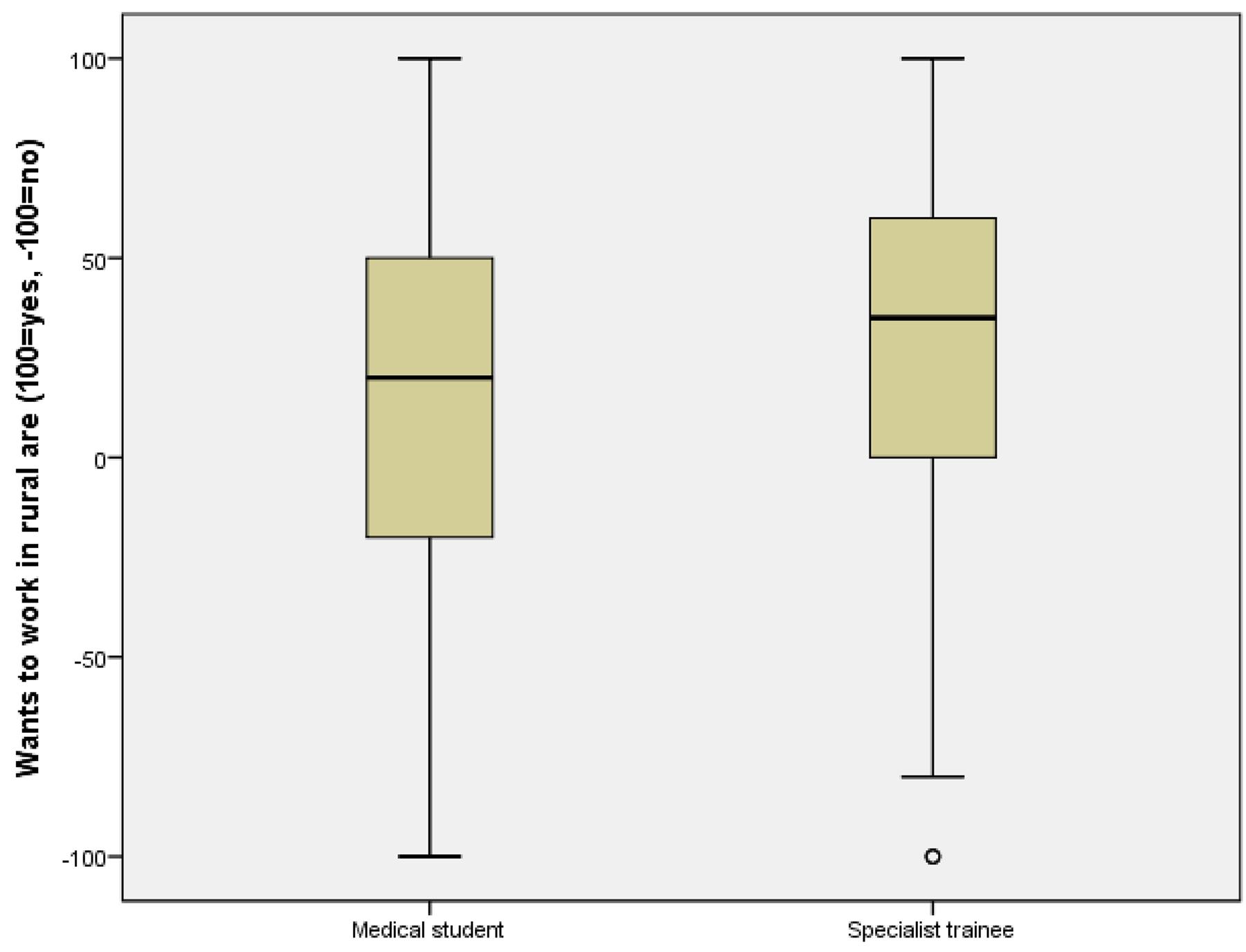 Figure 1: Intentions to work in a rural area, stratified by professional maturity, median and interquartile range.
Impact on the students’ career aspirations
The evaluation included only participants who had already completed their studies (n=176), as they were either about to choose their specialty or had already done so. The participants reported a positive impact of the project on their willingness to work in rural areas and on their decision to work in general practice.
Around 13.5% of specialist examinations in general practice were conducted in Germany in 20235. By comparison, the proportion of participants who elected to pursue further training in general practice after completing the ‘Excellent Project’ was 24.3%, representing an increase of approximately 11 percentage points5.
Table 3: Summary of all results
| Variable | Median (IQR) | Agreement / strong agreement (%) | Disagreement / strong disagreement (%) | Elected to pursue further general practice training (%) |
|---|---|---|---|---|
| Before participating in the ‘Excellent Project’ (for the first time), my ambition to become a GP was ... | –40 (–70–20) | |||
| Since participating in the ‘Excellent Project’ (last time), my desire to become a GP is ... | 30 (–12.5–52.5) | |||
| My (last) participation in the ‘Excellent Project’ showed me that working as a GP in a rural area is an option for me. |
20 (–20–50) (students) 35 (0–60) (specialists in training) |
|||
| The time spent on the ‘Excellent Project’ was wasted time for me. | 98.7 | |||
| During medical school, rural medical experience should be mandatory. | 3 (2–4) | |||
| During medical school, rural medical experience should be voluntary. | 4 (4–4) | |||
| Which medical specialty are you aiming for? / In which field do you hold your specialist title? | 23.4 | |||
| The time spent on the ‘Excellent Project’ was important for my personal medical development. | 92.3 | 1.8 | ||
| The time spent on the ‘Excellent Project’ was important for my future career aspirations. | 78.5 | 7.7 | ||
| My time on the ‘Excellent Project' has had a positive impact on my opinion of GPs. | 86.2 | 2.7 |
IQR, interquartile range.
Discussion
Key results
The study’s findings indicate that the ‘Excellent Project’ has a substantial impact on the career orientation of medical students. A particularly salient finding is that the propensity to practice general practice is not only elevated following an immersive rural medical experience in a GP practice, but also that this career trajectory is pursued at a rate almost double the German average, where only about 13.5% of all specialty board exams are taken in general practice5. This finding indicates that targeted practical experience in GP care, particularly in rural areas, can serve as an effective recruitment strategy for young doctors.
Strengths and limitations
A major strength of the project is its high response rate of 83% among participants. This provides a good overview of the participants’ attitudes toward their careers. Another notable strength of this study is its collection of participants' subjective assessments of the intervention's influence on their opinion formation. This provides insights into the perceived effectiveness of the measure. However, a limitation arises from the considerable time gap between the intervention and the survey. This discrepancy could have led to memory biases or alterations in the perception of the intervention. It is essential to recognize the potential limitations of retrospective self-reporting, as it is susceptible to social desirability bias and selective recall, which can compromise the validity of the results obtained.
The potential for biases to emerge due to recall bias was mitigated using transparent, retrospectively formulated questions. The phenomenon of social desirability declined when anonymous participation was employed. The possibility of selection bias resulting from voluntary participation cannot be discounted. Another limitation of this study is that baseline values were not available for the wish of working in a rural setting, making it impossible to analyze changes within the study group. Therefore, the result should be interpreted as descriptive of post-intervention attitudes rather than causal effects of the intervention.
Discussion of the findings
A long-term effect of the intervention can be observed: despite the passage of time, participants still attested to the strong impact of their internship experience on their decision-making, even years after finishing the project. This finding suggests that the personal and emotional connection to GP work, which was facilitated as part of the project, exerts a more significant influence than purely theoretical or urban training components.
This finding is especially significant given the ongoing shortage of GPs in rural areas7,9. It aligns with the prevailing assumptions in the health policy discourse, supporting the idea that positive early experiences in underserved areas can greatly impact future career location choices10-12.
The high effectiveness of the project can also be attributed to the fact that it allows students to gain first-hand insights into daily life in rural practices in an unbiased manner, far removed from stereotypical ideas. Concurrently, the project engendered opportunities for self-identification in a career context, relationship cultivation and introspection – components that are frequently disregarded in conventional curricula.
The findings suggest that such programs should not be viewed as isolated training initiatives, but rather as a deliberate and integrated component of a comprehensive junior staff development strategy within primary care settings. Their implementation should be a long-term commitment.
Despite the favorable outcomes, concerns have arisen regarding the project's generalizability. The participants in this project were voluntarily involved and, therefore, are possibly already more interested in working as a GP than the average medical student. This could have led to a selection bias that positively influenced the results. The specific framework conditions of the project – such as the personal support, the targeted selection of rural practices or the remarkable commitment of the supervising doctors – may also not be replicable to the same extent in other contexts.
Nevertheless, the results provide important indications of structural features relevant to the successful recruitment of junior doctors in general practice, including practical experience, early insights into GP care in rural areas and opportunities for developing positive professional identification. Basically, these components can also be adapted for use in other projects or curriculum measures. However, the prerequisite for nationwide implementation is the availability of suitable rural practices and the establishment of appropriate support structures.
Consequently, the generalizability of the results is constrained; however, the results do establish substantial starting points for the development and scaling of analogous programs, particularly within the context of prevailing supply bottlenecks.
Framing the findings within evidence
Numerous publications highlight the importance of direct, practical experience in medical education for fostering professional interest in general practice. It is essential to recognize the crucial role played by students’ active and personal involvement in general practice. Simply imparting knowledge about general practice as part of the curriculum is not considered sufficient for a career entry into general practice13,14.
As indicated by the findings of the study conducted by Chellappah and Garnham15, interaction with GPs during medical studies exerts a substantial impact on the perception of general practice. The integration of students into general practice beyond the conventional academic framework has the potential to catalyze positive change in this regard. A correlation exists between the extent of students’ exposure to the field of general practice and their subsequent decision to pursue a career in this field. The results of the present study can confirm the findings by Chellappah and Garnham.
Pols et al also advocate for greater visibility of general practice in university studies16. The realm should be presented as an attractive field of work with positive working conditions to increase interest in a possible career path. Sapoutzis et al posit a similar argument, proposing that educational programs specifically designed to prepare students for a future career as a GP could play a pivotal role in addressing the shortage of GPs17. The results of the ‘Excellent Project’ underscore the importance of not only promoting general practice as an attractive realm during university education but also enabling students to engage with it actively.
The correlation between personal experiences and subsequent career choice can also be inferred from studies on rural medical care. In this regard, various studies have shown that rural internships can make a significant contribution to establishing a personal connection between students and rural areas17-19. A prior study on the ‘Excellent Project’ also corroborated the significance of internships in rural areas. The participants articulated a substantial endorsement for the inclusion in practical training programs within rural regions. Furthermore, a considerable enhancement in the clarity of the roles of a GP and the notion of rural medical practice was observed20. This evaluation also confirms that a large proportion of participants have completed their internships in these regions.
This phenomenon could be extrapolated to the realm of general practice. Students who have positive experiences in a general practice during their studies and benefit from competent supervision may develop an emotional attachment to the discipline. The intensive, individualized support provided by the ‘Excellent Project’ may have contributed to the development of this emotional bond.
Conclusion
The ‘Excellent Project’ offers a compelling illustration of how targeted, early practical experience in rural areas can exert a profound and enduring influence on the career choices of medical students. The findings suggest that a structured and practice-oriented approach to general practice, particularly within the context of genuine rural care, is conducive to the decision to pursue further training in general practice. It is noteworthy that this effect is not only evident in the short term, but also several years after participation: almost twice as many former participants opted for general practice as the German average5.
Given the expected shortages in many rural areas and the increasing average age of practicing GPs, initiatives like this offer a valuable chance to tackle long-term care disparities. Despite the necessity of exercising caution when assessing the generalizability of the project given its particular framework conditions, the project nevertheless provides significant momentum for the development of forward-looking junior doctor strategies. The present study demonstrates that motivation and professional orientation can be promoted explicitly if medical students experience at an early stage how fulfilling, varied and relevant general practice work in rural areas can be.
Acknowledgements
The authors would like to thank AOK Bayern and GesundheitsregionPLUS for their valuable support in conducting the ‘Excellent Project’.
Conflicts of interest
The authors declare no conflicts of interest.
AI disclosure statement
No generative AI or AI-assisted artificial tools were used in the conduct of this research or the preparation of this manuscript.
Data availability statement
The data that support the findings of this study are available from the corresponding author upon reasonable request.
References
You might also be interested in:
2013 - Advanced rural skills training: are recently qualified GPs using their procedural skills?