


 download PDF
Uncertainty is a structural feature of remote health decisions
Health service planning in rural and remote regions is intrinsically characterized by uncertainty. Small population sizes, geographic isolation, transport dependency and constrained workforce availability all limit the completeness, granularity and reliability of routinely collected data. As a result, planners are frequently required to make infrastructure and service decisions based on partial information, proxy indicators or qualitative judgement rather than on comprehensive empirical evidence1-3.
In such contexts, the absence of local services often leads to forms of unmet need that are difficult to observe directly. Patients may forgo care entirely, experience delays that are not formally recorded or receive alternative management that masks the original access failure. These phenomena are widely acknowledged in the rural and remote health literature, particularly in relation to diagnostics, specialist access and emergency care, yet they are rarely quantified in a way that directly informs planning decisions1-4. Importantly, the absence of observable data does not imply absence of effect; in some cases, the service configuration itself prevents the underlying level of unmet need from being directly observed.
Despite these constraints, planning decisions must still be made. To manage uncertainty, health planning reports commonly include sensitivity analyses5-7, typically framed as variations of selected parameters by predefined percentages, followed by statements that results are ‘robust’. While this practice is methodologically orthodox and often expected, it frequently fails to clarify which assumptions actually matter for the decision at hand or under what conditions a different conclusion would emerge.
This commentary argues that, in remote health planning, robustness should not be reported as resistance to arbitrary parameter variation, but as the explicit identification of reversal thresholds: the values at which a planning conclusion would no longer hold. Threshold analysis itself is not proposed here as a new analytical method5,6. Rather, this commentary proposes the systematic reporting of reversal thresholds as a decision-oriented complement to conventional sensitivity analysis, particularly in remote settings where key parameters may be difficult or impossible to estimate directly. Making these thresholds explicit is particularly important when decisions depend on parameters that are structurally unobservable, such as unmet need, access failure or service non-use driven by geography.
Conventional sensitivity analysis underperforms in remote settings
Sensitivity analysis is routinely included in health planning and economic evaluations as a way of addressing uncertainty, typically by varying selected model inputs within predefined ranges and assessing whether conclusions change5-7. In practice, however, sensitivity analysis in remote health planning can exhibit several recurrent limitations that reduce its decision relevance.
To begin with, parameters of fundamentally different epistemic status are treated equivalently. Observable or contractual inputs such as equipment prices, staffing salaries or regulated tariffs are varied alongside parameters that are structurally unobservable, such as care forgone due to distance, delayed diagnosis attributable to lack of local services or patient ‘leakage’ to distant facilities1,2,4. Applying identical percentage ranges to these heterogeneous inputs implicitly suggests that all uncertainty is of the same nature, when in fact it arises from fundamentally different sources5,6.
Additionally, sensitivity analysis can be implemented as a procedural requirement rather than an analytical tool6,7. Multiple parameters are varied mechanically within conventional ranges (eg ±10% or ±20%), and conclusions are deemed robust if no reversal occurs. While this approach may satisfy reporting standards or peer-review expectations, it may fail to reveal which assumption actually governs the decision or whether the tested ranges correspond to any plausible real-world scenario.
Most importantly in remote contexts, the outputs of sensitivity analysis may be poorly aligned with the needs of health policy decision-makers. Statements saying that ‘results are robust to reasonable variation’ provide little guidance to planners who must assess the plausibility of alternative futures8. In settings where political, ethical and equity considerations are prominent, such statements may even obscure the true fragility of a conclusion by implying certainty where none exists1,8.
These limitations are not unique to remote health planning, but their consequences are amplified when key determinants of access and utilization are structurally unobservable and when service absence itself alters behaviour in ways that data systems are not designed to capture1,2.
Reframing robustness – from parameter variation to decision reversibility
An alternative way to frame robustness is to focus explicitly on decision reversibility rather than on parameter uncertainty per se. Instead of asking whether results are robust to arbitrary variation, analysts can ask a more direct and decision-relevant question: ‘Which assumption must change, and by how much, for the preferred option to cease being preferable?’5,6. The relevant analytical output then becomes the value at which the preferred decision changes, rather than simply the range over which the original conclusion remains unchanged. This reframing shifts attention from parameter uncertainty to decision reversibility.
This reframing requires that parameters be distinguished into three categories:
- Observable or contractual parameters include inputs that can be verified without altering the system under study, such as procurement prices, maintenance contracts and regulated tariffs. While these parameters may be subject to modest uncertainty, they can generally be bounded using directly available information and are therefore relatively amenable to conventional sensitivity analysis5,6.
- Forecastable parameters, such as population growth and disease incidence trends, are uncertain but bounded by external data sources, for example from regional or national databases and registries, and disease-specific scientific societies. Scenario analysis based on published projections can therefore be based on empirically informed ranges or alternative projections.
- In contrast, structurally unobservable parameters are those that cannot be directly measured without changing the service configuration itself. These may include unmet need due to absence of services, care renunciation linked to distance or travel burden, and delays that do not appear in administrative datasets. Such parameters are common in remote health contexts and often underpin qualitative arguments about access, equity and resilience1-4.
For these parameters, the goal of analysis is not necessarily to identify a single ‘true’ value, but to assess whether the decision depends critically on the assumption. Robustness, in this sense, is demonstrated by identifying the reversal threshold: the point at which a change in the parameter would alter the decision outcome. Formally, if two options A and B are compared using a decision criterion (D), the reversal threshold (x*) for an uncertain parameter (x) is the value at which DA(x*) = DB(x*), with the other stated assumptions held constant6. On either side of this threshold, the preferred option changes. Once this threshold is known, debate can shift from abstract discussions about uncertainty to concrete assessment of plausibility7.
An illustrative example: access-dependent service provision in remote regions
The relevance of reversal thresholds can be illustrated using access-dependent service provision in remote regions. Consider a geographically isolated population evaluating whether to rely on centrally supplied diagnostic services or to support local provision. Transport costs, time sensitivity and service availability interact in complex ways, and some patients may not access care at all when services are distant. The proportion of non-use attributable to absence of local provision is structurally unobservable because the patients who forgo care may never appear in the relevant administrative data1,2.
A conventional sensitivity analysis might vary utilization rates or transport costs within predefined ranges and conclude that results are robust5,6. A reversal-threshold approach instead asks directly how much transport costs or access-related non-use would need to change before the preferred service configuration reverses. This turns uncertainty about the parameter into a decision-relevant question about whether such a change is realistically plausible6.
This logic is illustrated schematically in Figure 1. Rather than testing arbitrary percentage changes alone, the analyst identifies the value of the uncertain parameter at which the preferred option changes.
In one such analysis, local provision remained cost-minimising across all plausible scenarios unless transport costs decreased by nearly half9. Expressed as a simple index, if current transport costs are represented by a value of 100, the decision would reverse only if they decreased to approximately 50. The precise estimate of current transport cost was therefore less informative than the identification of this reversal threshold. Decision-makers could immediately assess whether such a reduction was realistic, policy-relevant or implausible, without disputing the exact baseline value9.
Crucially, the conclusion was not presented as an absolute claim, but as a conditional statement. The analytical contribution lay not in predicting future costs with precision, but in making explicit the threshold below which the preferred option would no longer hold, and therefore the range of conditions over which it would remain preferable.
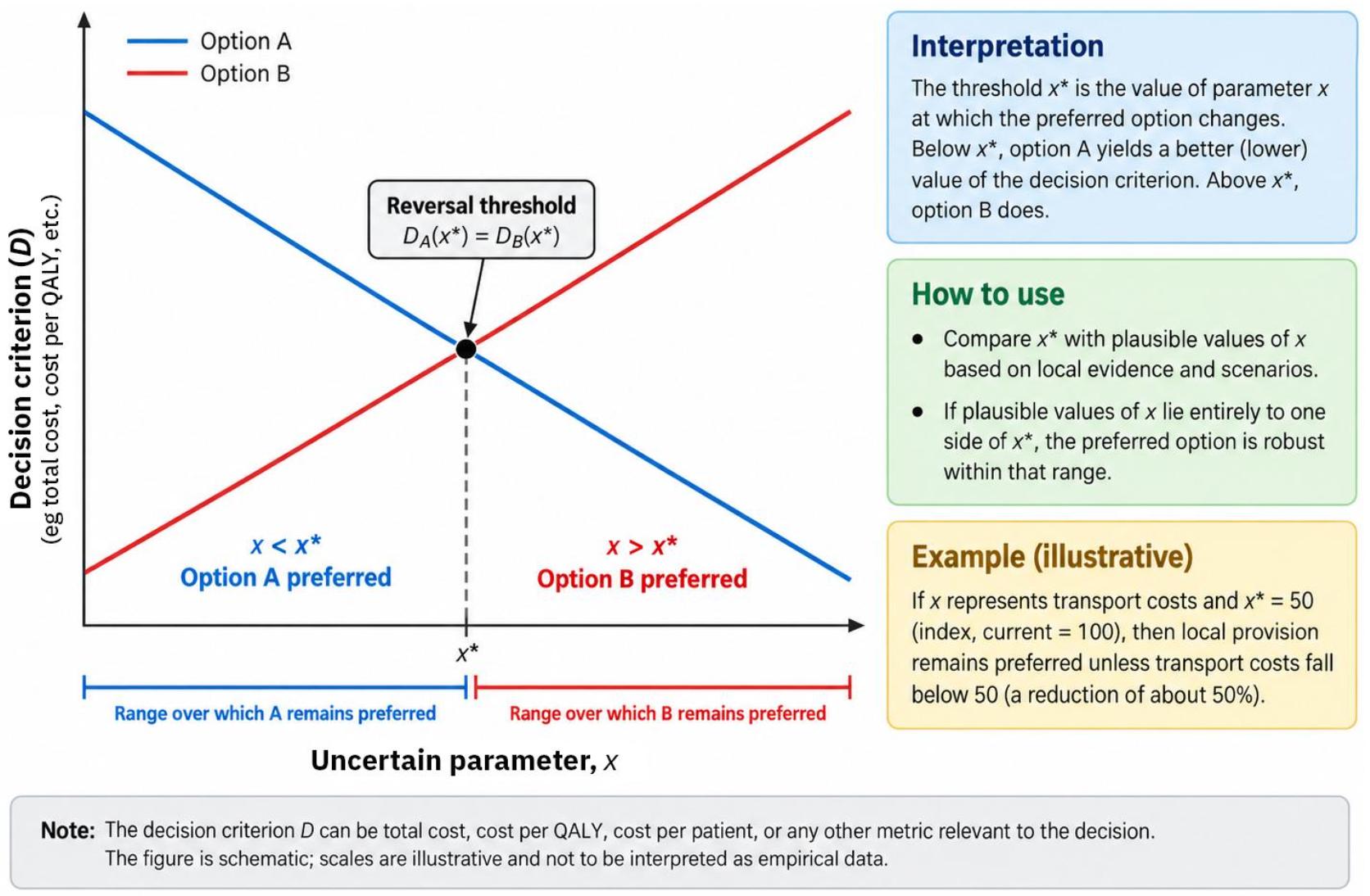 Figure 1: Illustration of a reversal threshold (x*) for two options under an uncertain parameter.
The preferred option depends on the value of parameter x. At the threshold x*, the decision criterion yields the same value for options A and B (DA(x*)=DB(x*)). To the left of x*, option A is preferred; to the right, option B is preferred.
Broader implications for rural and remote health planning
Expressing results in terms of reversal thresholds has several potential advantages for rural and remote health planning.
First, it enhances transparency. Explicitly identifying the assumptions that govern decisions allows stakeholders to understand where disagreement truly lies. This is particularly valuable in politically sensitive contexts, where debates about access and equity are often conducted qualitatively and where hidden assumptions can dominate outcomes. It can also help distinguish disagreements about empirical assumptions from disagreements about policy priorities or acceptable levels of risk7,8,10.
In addition, it reduces unproductive debate over arbitrary sensitivity ranges. Questions such as ‘Why ±20% rather than ±30%?’ become less central once the reversal point is reported, because the threshold is derived from the relationship between the uncertain parameter and the decision outcome rather than selected a priori as a sensitivity range5-7.
Moreover, it aligns analytical outputs more closely with decision-makers’ needs. Planners need more than an abstract statement that a model is robust; they also need to know under what real-world conditions an alternative option would become preferable and whether those conditions are plausible within foreseeable policy horizons8,10.
Reversal thresholds are likely to be most informative when a decision depends strongly on one or a small number of uncertain parameters whose plausible values are difficult to establish. They should therefore be viewed as a complement to, rather than a replacement for, conventional sensitivity or scenario analysis, particularly where uncertainty across multiple parameters must be considered simultaneously5-7.
Finally, this approach is potentially transferable across remote health contexts10-14. While the illustrative example concerns diagnostic service provision, the same logic could be applied to blood supply buffering, emergency service basing, specialist outreach, emergency helicopter or fixed-wing base location, and other settings where absence of local services generates hidden non-use or delayed care1,2,15.
Conclusion
Uncertainty is an unavoidable feature of rural and remote health planning. However, the way uncertainty is handled can either clarify or obscure decision-making. Conventional sensitivity analysis may provide reassurance without fully clarifying the conditions that determine the preferred option, particularly when conclusions depend on parameters that cannot be directly observed.
Reporting reversal thresholds offers a simple but powerful complement to existing practice. By explicitly stating the conditions under which conclusions would no longer hold, analysts can improve the transparency, credibility and usefulness of planning analyses in remote settings. The value of this approach lies not in more complex modelling, but in clearer articulation of what assumptions truly matter for decisions affecting access to care. Future applications should examine how readily such thresholds can be identified and communicated across different remote health services, and whether their explicit reporting improves the transparency and practical use of planning analyses.
Funding
No funding was received for this article.
Conflicts of interest
The author declares no conflicts of interest.
AI disclosure statement
ChatGPT version 5 was used for English language improvement. The author has reviewed the AI changes and takes full responsibility for the final published work.