




 download PDF

Introduction
Technological advancements over the past two decades have made ultrasound devices more portable, affordable, and user-friendly, facilitating increased use of bedside point-of-care ultrasound (PoCUS) by clinicians1. This includes family physicians (FPs) who report that PoCUS is an extension of a physical exam and compatible with their knowledge and skills as generalists2,3. The wide range of PoCUS applications by FPs shows the extent to which it can be integrated into generalist day-to-day practice2,4-8.
If FPs are skilled in PoCUS and use it during a patient assessment, they can access additional information that would not have been immediately available otherwise, potentially increasing their diagnostic certainty6,9,10. This may then facilitate safe de-escalation or escalation of care9,11, allowing patients to receive more timely and appropriate care in the most advantageous location. Studies from different jurisdictions examining PoCUS use by FPs have found that, overall, PoCUS leads to less costly and specialized care6,9,11. The potential value of PoCUS is even greater in low-resourced rural settings, where local consultative imaging and specialist services are limited or absent.
Clinical studies from several high-income countries have evaluated the usefulness of PoCUS for FPs6,9,10,12; two of these studies were from a rural setting9,10. There is a need for this type of evidence from rural Canada, where FPs have long been using PoCUS, particularly in EDs4,5,13. Compared to other countries where multi-site clinical PoCUS studies have taken place, Canada is geographically much larger and has a more extreme climate, which may make travel to access health care challenging. Additionally, the recent regionalization of health services in Canadian provinces/territories such as British Columbia (BC) has resulted in a greater concentration of services in urban centres, further isolating rural communities14,15. Within this context, the present study aimed to measure the extent to which PoCUS affects FPs’ diagnostic certainty and their clinical decision-making in rural BC.
Methods
We undertook an observational prospective cohort study. The exposure of interest was diagnostic use of PoCUS by FPs in rural settings for any clinical presentation among adult patients. Study outcomes were determined through a pre–post survey completed by FPs (Supplementary material I). For each patient assessment, FPs entered their diagnostic probability for their main PoCUS diagnosis and their patient management plan immediately before and after PoCUS.
FPs were asked to collect data in primary, ED, and/or hospital inpatient settings over 6 weeks. To help ensure a random sample of scans and minimize disruptions to clinical workflows, FPs were asked to record data for their first scan in a clinical shift/day and up to two more scans that shift/day if feasible. FPs also completed a short online survey about their own demographic characteristics and clinical experience (Supplementary material II).
All data were collected in the University of British Columbia Faculty of Medicine’s Research Electronic Data Capture platform. Information on the communities where FP participants practiced was obtained from Statistics Canada and BC Health Authority websites.
During analysis, each diagnostic probability was assigned to one of three diagnostic certainty categories (Fig1). This schema was based on the lexicon used by radiologists at Harvard University affiliated medical institutes to communicate diagnostic certainty16. Each pre- and post-PoCUS patient management plan was assigned to one of six levels of care according to the highest level of care specified in the plan.
The Wilcoxon signed-rank test for clustered data was used to assess the statistical significance of observed changes from pre- to post-PoCUS in diagnostic certainty (one-sided test) and the planned level of care (two-sided test). Scans were grouped/clustered by FP. As data were collected immediately before and after the exposure (PoCUS), confounding by temporal factors was minimized. Data were analyzed in SPSS v28 (IBM Corp; https://www.ibm.com/products/spss-statistics) and R v4.3.2 ((R-Project for Statistical Computing; https://www.r-project.org). The Datta–Satten method in the R ‘clusrank’ package17 was used to analyze study outcomes.
The inclusion criteria for FP participants (Appendix I) helped ensure a minimum level of PoCUS education and competency. To recruit FPs, the study team and study partners distributed a recruitment flyer through email, social media, and/or their organizational websites. Study team members also sent emails to rural FPs in their professional networks who use PoCUS. All recruitment activities occurred in 2022.
 Figure 1: Diagnostic probability and certainty for main point-of-care ultrasound diagnoses by family physicians.
Ethics approval
The University of British Columbia Clinical Research Ethics Board provided ethics approval for the study (ethics certificate: H21-01412).
Results
Five FPs, each practicing in a different community, joined the study (see Appendix II for information on communities). All FP participants had completed at least two types of formal PoCUS training after undergraduate medical school and typically used PoCUS at least once per clinical shift/day. See Table 1 for more information on FPs’ clinical practice characteristics.
The pre–post survey data collection period lasted from August 2022 to February 2023, with FPs starting and stopping data collection at different times. Altogether, FPs collected pre–post PoCUS data on 68 patient assessments. Although FPs were asked to collect data for 6 weeks, the total number of data collection weeks ranged from two to ten.
There were more female patients than male patients in the study sample (60% v 40%). Though patients ranged in age from 18 to 100 years, 80% were aged at least 40 years. The median age was 59 years. Most exams occurred in an ED (Table 2), and FPs used PoCUS for a variety of applications (Table 3).
Overall, diagnostic certainty increased for the main PoCUS working diagnosis after PoCUS use. Diagnostic certainty increased for 46 cases (68%), remained the same for 19 (28%), and decreased for three (4%) (p=0.01; Fig2).
From pre- to post-PoCUS, there was a decrease in the number of care options selected and an overall shift to less specialized care (Table 4). The highest level of care specified in a patient management plan remained unchanged after PoCUS for 43 patients (63%), decreased for 22 (32%), and increased for three (4%) (p=0.08; Fig3).
For 13 patients, there was a change in planned out-of-town transport or referral. Transport is more urgent, and the healthcare system provides (typically one-way) travel to a higher level of care. A referral is less urgent and, though community support may be available, patients are responsible for their round-trip travel. Overall, travel was avoided for eight patients and added for four other patients. For one patient whose care plan changed from transport to referral out of town, the need to travel did not change. In total, transport was removed for four patients and added for two other patients.
See Appendix III for research outcomes by FP participant.
Table 1: Family physician characteristics – clinical practice and point-of-care ultrasound experience
| Characteristic | Variable | n (%) |
|---|---|---|
| Practice experience (years) | <5 | 1 (20) |
| 5–10 |
1 (20) |
|
| >10 |
3 (60) |
|
| Rural practice experience (years) | <5 | 2 (40) |
| >10 |
3 (60) |
|
| Clinical setting(s) in which PoCUS is used | ED | 5 (100) |
| Primary care |
3 (60) |
|
| Hospital – inpatient |
2 (40) |
|
| Long-term care |
1 (20) |
|
| Typical number of on-call shifts in a week | 2 | 1 (20) |
| 3 |
1 (20) |
|
| 4 |
3 (60) |
|
| Typical number of clinical days in a week | 3 | 2 (40) |
| 5 |
3 (60) |
|
| PoCUS experience (years) | 2–5 | 2 (40) |
| >10 |
3 (60) |
|
| Type(s) of ultrasound device used | Cart-based | 5 (100) |
| Handheld wireless |
3 (60) |
PoCUS, point-of-care ultrasound.
Table 2: Clinical settings where point-of-care ultrasound was used (n=68)
| Clinical setting | n (%) |
|---|---|
| ED | 59 (87) |
| Primary care clinic | 7 (10) |
| Hospital inpatient unit | 2 (3) |
Table 3: Main point-of-care ultrasound working diagnoses (n=68)
| Organ system | Main PoCUS working diagnosis† |
|---|---|
| Cardiac (n=13) |
Anterior STEMI Congestive heart failure Cardiomyopathy Fast atrial fibrillation Left ventricular hypertrophy Myocardial infarction Myocarditis post-COVID-19 vaccine Reduced ejection fraction due to NSTEMI Structural heart disease |
| Comprehensive (n=2) | Abdominal bleeding |
| Gastrointestinal (n=11) |
Appendicitis Cholecystitis Diverticulitis Gallstone Gastritis Splenomegaly |
| Genito-urinary (n=7) |
Kidney stone Pyelonephritis Renal colic Spermatocele |
| Obstetrics/ gynecology (n=7) |
Ectopic pregnancy Ovarian cyst Polyhydramnios Postmenopausal bleeding / hyperplasia |
| Ocular (n=5) |
Lid abscess Retinal detachment Vitreous detachment |
| Respiratory (n=9) |
Chronic obstructive pulmonary disease COVID-19 Pneumonia |
| Skin and musculoskeletal (n=9) |
Abscess (excluding lid) Foreign body in hand Lipoma Metacarpal fracture Rib fracture Septic prepatellar bursitis |
| Vascular (n=4) |
Abdominal aortic aneurysm Deep vein thrombosis Pulmonary embolism |
| Other (n=1) | Chest tube malfunction |
† Each diagnosis may correspond with more than one patient assessment.
PoCUS, point-of-care ultrasound. STEMI, ST-segment elevation myocardial infarction.
Table 4: Patient management plans before and after point-of-care ultrasound (n=68)
| Level of care | Plan† | Pre-PoCUS (n) | Post-PoCUS (n) | Change from pre- to post-PoCUS (n) |
|---|---|---|---|---|
| 5 | Transport out of town to a higher level of care (by air and/or road) | 9 | 7 | –2 |
| 4 | Admit to current hospital | 7 | 11 | +4 |
| Additional observation, assessment and/or treatment in the ED |
33 |
14 | –19 | |
| 3 | Out-of-town referral to consultative imaging | 8 | 5 | –3 |
| Out-of-town referral to a non-imaging specialist physician |
3 |
3 | 0 | |
| 2 | Local referral to consultative imaging | 16 | 13 | –3 |
| Local referral to a non-imaging specialist physician |
4 |
5 | +1 | |
| 1 | Treatment in current primary care clinic | 0 | 1 | +1 |
| Follow-up in current/local primary care clinic |
4 |
12 | +8 | |
| Physiotherapy referral |
0 |
1 | +1 | |
| Biopsy and lab |
1 |
0 | –1 | |
| 0 | Discharge without referral or follow-up | 4 | 7 | +3 |
| Total | 89 | 79 | –10 |
† One patient management plan may have listed more than one type of care. The following level 4 care options were not selected at pre- or post-PoCUS: additional assessment and/or treatment in an inpatient unit, emergency referral to a local hospital, and non-emergency referral to a local hospital.
PoCUS, point-of-care ultrasound.
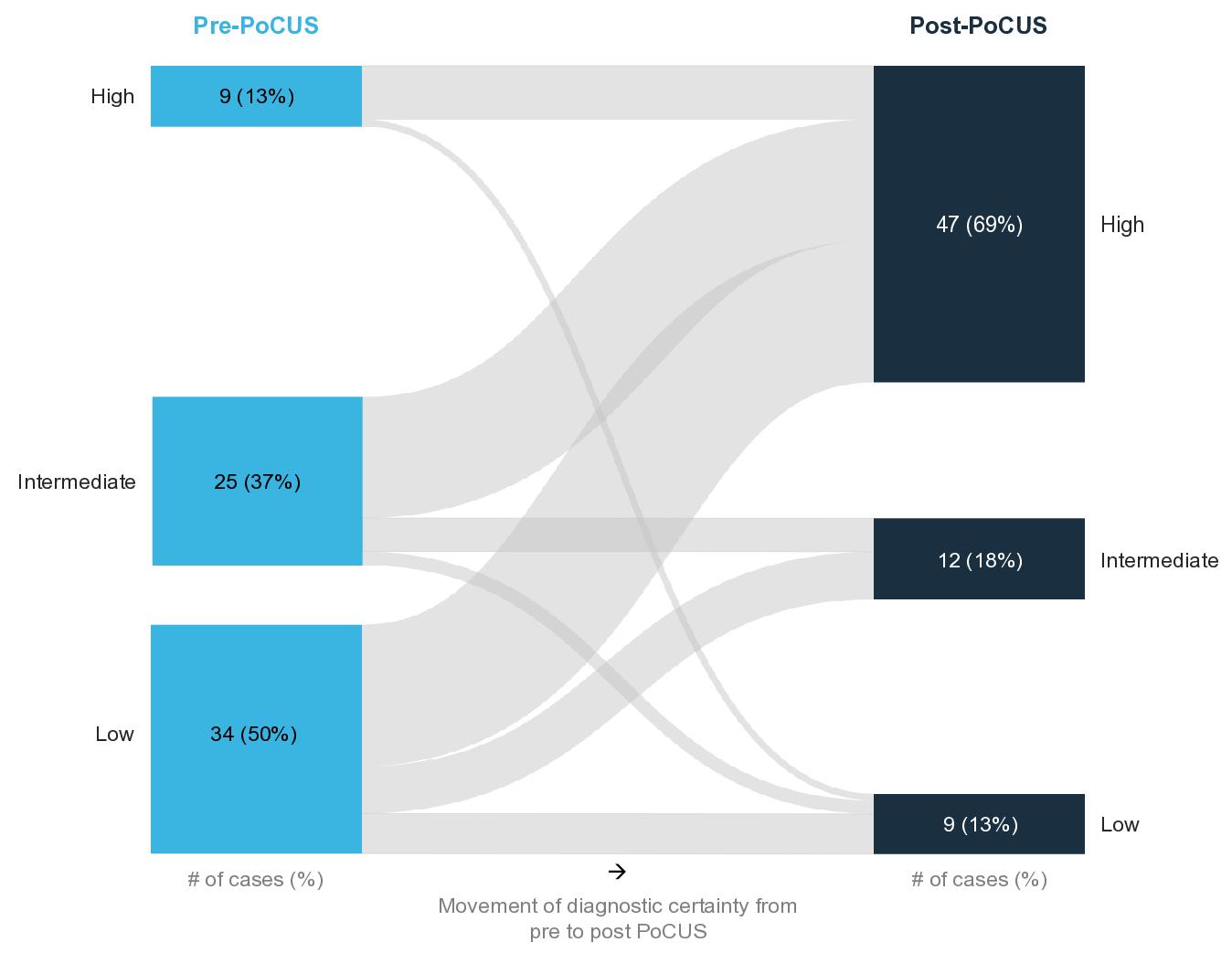 Figure 2: Diagnostic certainty at pre- and post-PoCUS for the main PoCUS working diagnosis (n=68 at each time point). PoCUS, point-of-care ultrasound. Diagnostic certainty categories correspond to diagnostic probability ranges. High corresponds to ≤5% or ≥90%, intermediate to 6–24% or 75–89%, and low to 25–74% (Fig1). The thickness of each line is sized proportionally to the number of cases flowing from a pre-PoCUS certainty category to a post-PoCUS certainty category.
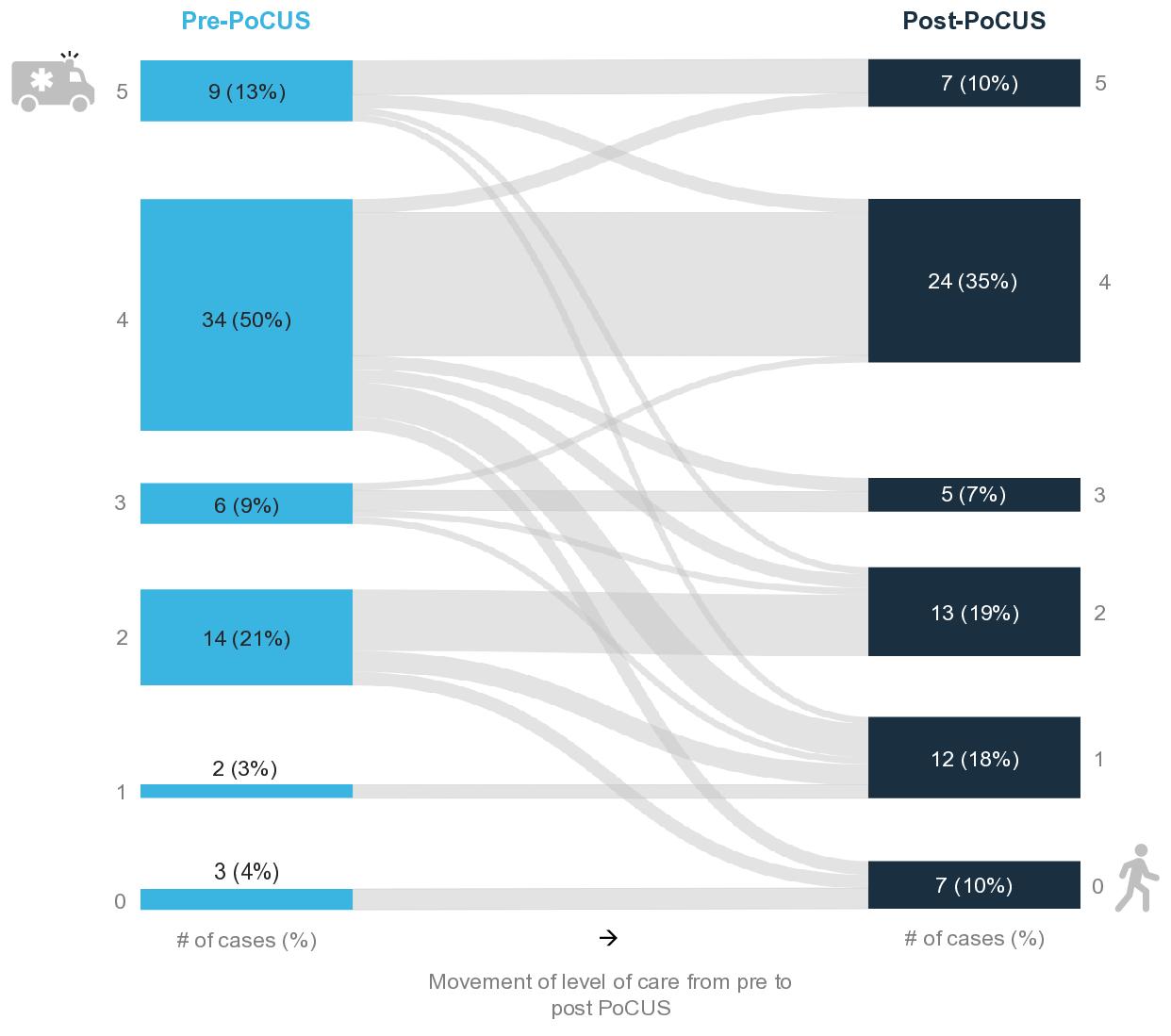 Figure 3: Highest level of care specified in a patient management plan at pre- and post-PoCUS (n=68 at each time point). 5 = out-of-town transport; 4 = local hospital-based care; 3 = out-of-town imaging or specialist referral; 2 = local imaging or specialist referral; 1 = local primary health care; 0 = discharge without referral or follow-up. The thickness of each line is proportional to the number of cases flowing from a pre-PoCUS level of care to a post-PoCUS level of care. PoCUS, point-of-care ultrasound.
Discussion
The present study found that, overall, across a wide range of applications, PoCUS had a positive impact on the diagnostic process for rural FPs by increasing their diagnostic certainty for a majority of cases in which PoCUS was used. We also found that PoCUS led to both escalations and de-escalations of care but resulted in an overall shift toward less specialized care. These findings are consistent with other studies that examined the utility of PoCUS for FPs6,9,10.
The change in patient management in our study was not statistically significant. Great variation in this outcome by FP (cluster effect), combined with lower than anticipated FP and scan sample sizes, decreased statistical power (the ability to detect a true difference).
For 12 patients, there was a change in the need to travel out of town after PoCUS use, with travel avoided for eight patients and travel added for four other patients. If these patients travelled from their rural community to the nearest referral centre and back by road and/or sea, the calculated net change in round-trip travel was –1980 km.
After PoCUS use, urgent transport to a higher level of care was deemed no longer necessary for four patients and now necessary for two other patients. Transports that are appropriately avoided, even if they do not happen often, result in major cost savings not only for the healthcare system but also for patients and their families. Conversely, the ability to recognize sooner that a patient urgently needs more specialized care may greatly improve their health outcomes.
Our findings support reports from FPs in BC regarding the benefit of PoCUS for rural practice2,13. At the same time, rural FPs can face considerable challenges in learning and using PoCUS, indicating a need for more systemic and infrastructural PoCUS supports2,18-20. Challenges reported by FPs in Canada and elsewhere include the cost of training and scanners, lack of remuneration for PoCUS exams, and the absence of local formal quality assurance frameworks for PoCUS2,4,5,8,13,21. A challenge specific to the rural context is physical distance from PoCUS training centres and networks of PoCUS peers and mentors2,13.
Conclusion
This is the first clinical study from rural Canada to examine the clinical effects of PoCUS for multiple FPs across different rural communities. We found that PoCUS, used by FPs for a wide variety of patient concerns in rural BC, increased diagnostic certainty in approximately two-thirds of cases and changed clinical decision-making in approximately one-third of cases. Our findings, if validated by larger studies, would likely help to drive change in PoCUS practice and policy in Canada.
Acknowledgements
The authors gratefully acknowledge funding support from Canada’s Digital Technology Supercluster and Mitacs, as well as administrative support from Providence HealthCare Ventures and the Rural Coordination Centre of British Columbia.
Funding
This work was supported by funding from Canada’s Digital Technology Supercluster (grant number GR020112) and Mitacs (grant number GR029291).
Conflicts of interest
All authors have no competing interests to declare.
AI disclosure statement
No generative AI or AI-assisted artificial tools were used in the conduct of this research or the preparation of this manuscript.