


 download PDF
Introduction
Disability and rehabilitation in rural and remote contexts are increasingly recognised as critical components of equitable health systems, yet they remain under-resourced and under-theorised in many low- and middle-income countries. Rural and remote health scholarship highlights how geography, poverty, workforce shortages, and weak service integration intersect to produce persistent health inequities1. In South Africa, these challenges are compounded by a legacy of apartheid-era spatial and social exclusion that systematically marginalised rural populations and rendered disability largely invisible within formal health systems, not because people with disabilities were absent, but because they were under-identified, undocumented, and excluded from health planning processes1.
Disability, as defined by WHO, encompasses impairments, activity limitations, and participation restrictions that arise from the interaction between individuals and their environments2. Rehabilitation refers to a broad set of interventions designed to optimise functioning and enhance participation across the life course. Globally, more than 1.3 billion people experience significant disability, with the highest unmet rehabilitation needs found in rural and resource-constrained settings2.
In South Africa, disability prevalence remains underestimated, particularly in rural areas where under-reporting, limited access to services, and social stigma persist. While official census data estimate disability prevalence at approximately 5.3%, alternative analyses suggest significantly higher rates, especially in historically marginalised communities3. These disparities underscore the importance of examining not only service availability, but also the sociopolitical processes that have shaped rehabilitation responses in rural and remote settings4.
In this article, the terms ‘hidden’ and ‘invisible’ are used critically to describe how disability was constituted within health systems and policy discourses. We do not suggest that people with disabilities were absent or concealed themselves. Rather, disability was present but frequently unrecognised, under-reported, and excluded from formal systems of care. The notion of ‘hidden’ reflects how early practitioners described their findings when encountering unmet need in rural areas, while ‘invisibility’ points to the role of structural inequities, limited outreach, and dominant biomedical models in shaping what was seen, recorded, and responded to. These distinctions are important in recognising the power dynamics that influence whose needs are acknowledged within health systems.
The history of disability and rehabilitation in rural South Africa is deeply embedded within the country’s broader sociopolitical landscape, particularly the legacy of apartheid and its spatial, racial, and economic inequalities5. During the apartheid era, health and rehabilitation services were structured around a highly centralised, hospital-based model that primarily served urban and white populations5. Rural areas, particularly those designated as ‘homelands’, were systematically under-resourced, resulting in limited access to health care and virtually no rehabilitation services. Within this context, disability was not absent, but largely unrecognised and excluded from formal health planning and records, reflecting how health systems rendered disability invisible rather than its actual absence5.
Within this context, disability in rural communities was largely understood through cultural and traditional lenses rather than biomedical frameworks6. Traditional healers played a significant role in promoting impilo (Zulu for ‘wellbeing’), yet these practices were poorly understood and often dismissed by Western-trained health professionals, many of whom lacked fluency in local languages and cultural competence7. The dominance of a curative, medical model of care, combined with limited outreach into rural communities, meant that children and adults with disabilities were rarely identified, referred, or supported in formal health systems8.
From the 1960s onwards, faith-based organisations and medical mission projects began to reveal the extent of what later became known as ‘hidden’ rural disability. This term referred to the fact that disability was rarely identified and supported. In northern KwaZulu-Natal, initiatives led by the faith-based organizations documented high levels of disability linked to malnutrition, tuberculosis, drought, and migrant labour systems9. These early interventions often combined medical care with self-help, occupational activities, and income-generating initiatives, particularly targeting rural women and families9.
The 1980s marked a significant shift with the emergence of community-based rehabilitation (CBR), influenced by the Alma-Ata Declaration on Primary Health Care and the global movement toward ‘Health for All’10. In the absence of sufficient professional rehabilitation staff, rural therapists and communities embraced CBR as a means of demystifying rehabilitation and extending services beyond hospital walls11. The publication of practical manuals such as Disabled Village Children provided accessible knowledge that enabled families and community workers to participate actively in rehabilitation processes7.
During this period, rural rehabilitation practitioners formed networks such as the Rural Disability Action Group (RURACT), creating platforms for collaboration, advocacy, and innovation. These networks linked rural therapists with Disabled People South Africa (DPSA), facilitating the mobilisation of persons with disabilities and embedding the principle of ‘Nothing about us without us’ within rural rehabilitation practice7,12,13. Such collaborations laid the foundation for a gradual shift from a medical model of disability toward a social and rights-based approach13.
Following the democratic transition in 1994, disability and rehabilitation gained greater visibility within national policy frameworks14. South Africa ratified the UN Convention on the Rights of Persons with Disabilities in 2007, and subsequent policies such as the White Paper on the Rights of Persons with Disabilities and the Framework and Strategy for Disability and Rehabilitation sought to address historical inequities15. However, the legacy of apartheid continues to shape rural rehabilitation, with persistent challenges related to funding, workforce capacity, and service integration16. This historical trajectory underscores the enduring importance of community-driven, collaborative approaches to rehabilitation in rural South Africa.
Historically, rehabilitation services in South Africa were institution-based, urban-centred, and grounded in a medical model of disability that prioritised impairment correction over participation and inclusion11. During apartheid, rural Black South Africans had minimal access to rehabilitation, and disability was largely absent from mainstream rural health planning. Cultural beliefs, language barriers, and the exclusion of traditional understandings of health further limited the relevance and reach of rehabilitation services in rural communities17.
Against this backdrop, innovative responses emerged from faith-based organisations, rural health practitioners, and communities themselves. From the 1960s onward, medical mission projects and self-help initiatives in rural KwaZulu-Natal and other regions began to reveal what was later described as ‘hidden’ rural disability17,18. These initiatives laid the groundwork for CBR, a participatory approach aligned with primary healthcare principles and later reinforced by global disability rights movements18,19.
This article examines the historical evolution of disability and rehabilitation in rural South Africa through a qualitative document review of archival materials held by the Disability Action Research Team (DART), a voluntary association of two postgraduate South African occupational therapists who had worked in rural and peri-urban communities from 1978 to 1990. By tracing key phases, actors, and collaborative practices from the 1960s to the present, the study highlights how end-user participation, rural professional networks, and advocacy have influenced rehabilitation practice and policy. The analysis contributes to rural and remote health scholarship by foregrounding community-driven responses to structural inequity and by drawing lessons for strengthening rehabilitation systems in rural contexts.
Methods
Study design
This study adopted a qualitative document review design, to explore policy development, service evolution, and system-level change over time.
Data sources
Primary data sources comprised archival documents housed by DART. The DART archive contains extensive historical records related to rural disability and rehabilitation, as seen as Appendix I, including:
- unpublished research reports and evaluations
- program and project documentation
- policy submissions and advocacy materials
- training curricula and manuals for community-based rehabilitation workers
- organisational correspondence, memoranda, and conference proceedings.
Documents reviewed spanned the period from the early 1960s to 2025 and reflected activities across multiple rural and remote regions of South Africa.
Inclusion and selection of documents
Documents were purposively selected based on their relevance to rural and remote rehabilitation, community-based rehabilitation, disability rights, and end-user participation.
Inclusion criteria were:
- explicit focus on rural South African contexts
- relevance to disability, rehabilitation, or CBR
- authored or commissioned by organisations, programs, or stakeholders engaged in rural rehabilitation practice or policy.
Data analysis
Documents were analysed using qualitative thematic analysis. An iterative process of reading, coding, and categorisation was undertaken to identify recurring themes, historical phases, and critical turning points. Attention was paid to how disability was conceptualised, how services were organised, and how collaboration with persons with disabilities influenced practice and policy.
One author’s long-term involvement in several of the documented initiatives provided contextual insight that supported interpretation while remaining grounded in the documentary evidence.
Ethics approval
Permission to access and analyse the DART archives was obtained from organizational leadership. As the study involved historical documents rather than human participants, no individual consent was required. Ethical principles of respect, transparency, and accurate representation of historical records were upheld throughout.
Results
The qualitative document review yielded several interrelated themes that characterise the evolution of rehabilitation and disability responses in rural South Africa. These themes reflect both historical shifts and enduring structural challenges in rural and remote health systems.
An overview of the findings is shown in Figure 1.
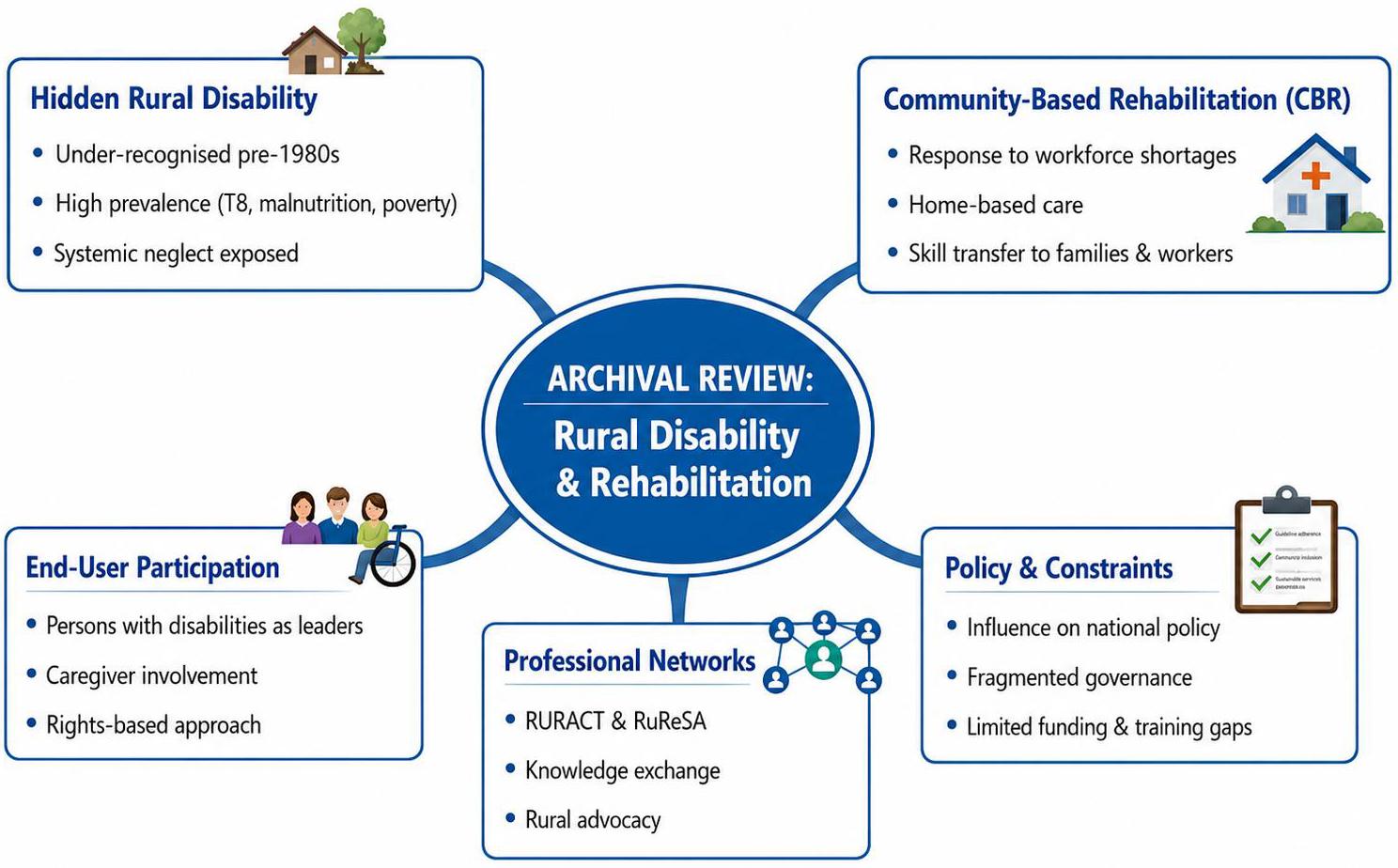 Figure 1: Archival review of rural disability and rehabilitation in South Africa: overview of key findings, early 1960s to 2025.
Visibility of ‘hidden’ rural disability
Archival documents consistently described how disability in rural communities was largely under-identified by formal health services prior to the 1980s. Mission hospitals, community surveys, and early research reports revealed a high prevalence of preventable and untreated impairments associated with malnutrition, tuberculosis, and poverty. These patterns reflect the presence of disability within these communities, and point to systemic gaps in how health services identified, recorded, and responded to disability, rather than an absence of disability itself.
Emergence of community-based rehabilitation as a rural response
CBR emerged as a pragmatic and ideological response to severe workforce shortages and inaccessible institution-based care. Documents traced how rural therapists and community actors adapted international CBR principles to local realities, emphasising demystification of rehabilitation, home-based care, and skill transfer to families and community workers.
End-user participation and leadership
A strong theme across documents was the central role of persons with disabilities, caregivers, and parents in shaping rehabilitation initiatives. Training programs prioritised the inclusion of people with disabilities as community rehabilitation workers and facilitators, reinforcing a shift toward rights-based and participatory practice.
Professional networking and rural advocacy
The formation of rural professional networks such as RURACT and later Rural Rehab South Africa (RuReSA) was repeatedly identified as critical for sustaining innovation, knowledge exchange, and advocacy. These networks enabled rural practitioners to collectively influence policy debates and training models.
Policy influence and systemic constraints
While rural initiatives contributed to national policy development, documents also highlighted persistent barriers to implementation, including fragmented governance, limited funding, and the discontinuation of mid-level rehabilitation training.
The qualitative document review of archival materials revealed a rich and layered account of the evolution of disability and rehabilitation in rural South Africa. Analysis of reports, evaluations, training materials, and organisational records spanning more than five decades identified a set of interrelated themes that reflect both historical change and persistent structural constraints affecting rural and remote rehabilitation systems.
A dominant theme across the documents was the early invisibility of disability in rural communities. Prior to the 1980s, disability was largely absent from formal rural health records and planning processes, reflecting both limited routine data collection and a lack of systematic attention to disability within health services. However, archival surveys, mission hospital reports, and practitioner accounts provide evidence of the presence of disability, documenting high levels of untreated and preventable impairment linked to malnutrition, birth trauma, infectious diseases, TB and genetic disorders. These findings challenged prevailing assumptions among policymakers and health professionals that disability prevalence was low in rural areas, pointing instead to systemic under-documentation and neglect rather than epidemiological rarity.
The documents consistently highlighted the role of faith-based organisations and medical mission projects in making rural disability visible. Initiatives led by church-based hospitals and community projects in KwaZulu-Natal and other rural regions documented disability through outreach, home visits, and community engagement. These efforts provided some of the earliest empirical evidence of rural disability and demonstrated the limitations of hospital-centred care in geographically dispersed and impoverished communities.
Another key finding was the emergence of CBR as a response to severe human resource shortages and inaccessible institutional services. While archival records already indicated high levels of untreated impairment, these data were often fragmented and not systematically translated into coordinated health service responses. In this context, CBR emerged as a practical and collaborative approach to address unmet rehabilitation needs that were visible within communities but insufficiently recognised within formal systems. Archival records show how rural therapists adapted international CBR principles to local realities by shifting rehabilitation activities into homes and communities, emphasising practical problem-solving, functional participation, and empowering families rather than relying on scarce specialist services. These patterns highlight the role of health systems not only in generating evidence, but also in responding to it, underscoring the importance of sustained investment in community-level workforce development, including mid-level rehabilitation workers.
End-user participation emerged as a central feature of effective rural rehabilitation initiatives. Training programs documented in the archives consistently prioritised the inclusion of persons with disabilities, parents, and of caregivers as community rehabilitation workers and facilitators. These programs not only expanded service reach but also reshaped rehabilitation relationships, positioning persons with disabilities as knowledge holders, educators, and advocates within their communities.
The development of mid-level rehabilitation workers was identified as a significant outcome of early CBR initiatives. Documents detailed multiple training models – short in-service courses and longer distance-learning programs – that equipped community members to deliver basic rehabilitation, advocacy, and referral services. Evaluations consistently reported improved access, continuity of care, and community awareness as a result of these cadres operating in rural areas.
Professional networking and collaboration emerged as another strong theme. Archival material traced the formation and activities of rural professional collectives such as RURACT, CBR Education and Training for Empowerment (CREATE), and later RuReSA. These networks enabled rural practitioners to share knowledge, support innovation, conduct research, and collectively advocate for policy change. They also served as critical support structures for practitioners working in professional isolation.
The findings further demonstrated the influence of rural initiatives on national disability and rehabilitation policy. Evidence from the archives showed how research findings, pilot projects, and advocacy by rural networks informed the development of national frameworks, including the National Rehabilitation Policy and later disability rights policies. However, documents also highlighted tensions between grassroots innovation and formal policy processes. These tensions included differences in priorities, with community-driven initiatives emphasising participation, local relevance, and continuity of care, while formal systems often prioritised standardisation, professionalisation, and resource constraints. Archival records further indicated challenges in translating locally generated evidence into sustained policy action, with successful pilot initiatives not consistently scaled or funded within the health system. In some instances, participatory and community-based approaches, including the development of mid-level rehabilitation workers, were not fully recognised or integrated into formal workforce planning, reflecting broader disconnects between policy intent and implementation. These tensions point to the need for stronger alignment between community-led innovation and health system structures to ensure that evidence-informed, contextually appropriate practices are sustained over time.
Despite policy advances, persistent implementation challenges were evident throughout the reviewed period. Reports repeatedly identified inadequate funding, fragmented governance, weak referral systems, and shortages of trained personnel as barriers to sustaining rural rehabilitation services. The termination of mid-level rehabilitation worker training programs emerged as a particularly significant setback, undermining gains achieved through decades of community-based practice.
Finally, the documents reflected a gradual conceptual shift from CBR toward disability-inclusive development. Later records showed increased engagement with education, livelihoods, governance, and human rights, positioning rehabilitation within a broader social and developmental agenda. While this shift expanded the scope of disability work in rural areas, the findings indicated that its success remained contingent on sustained community participation, strong local networks, and supportive policy implementation.
Discussion
This study provides a historically grounded analysis of rehabilitation in rural South Africa, illustrating how community-driven and participatory responses emerged within contexts of systemic exclusion, poverty, and limited state provision. Using a qualitative document review of the DART archives, the findings confirm that rural rehabilitation practice developed largely outside formal institutional frameworks, a pattern also observed in broader analyses of rural and primary health care in South Africa20. Despite their marginal positioning, these rural initiatives significantly influenced national disability discourse and policy, supporting literature that suggests innovation in low-resource and rural settings often emerges from the periphery rather than centralised systems21.
The findings demonstrate that disability in rural South Africa remained largely under-identified within apartheid-era health systems until deliberate efforts were made to document lived realities. Disability is and was always there, but this under-identification was another layer of segregation. Mission hospitals, community surveys, and practitioner-led research revealed high levels of preventable and untreated disability associated with malnutrition, tuberculosis, and poverty. This confirms earlier epidemiological and qualitative studies highlighting systematic neglect of rural disability and the limitations of urban-biased health planning models12,22. These findings also align with global evidence indicating that under-identification of disability remains a major barrier to equitable rehabilitation in rural and resource-constrained settings23.
CBR emerged in the reviewed documents as a pragmatic and ideological response to severe workforce shortages and inaccessible institution-based services. Rather than replicating urban rehabilitation models, rural practitioners adapted international CBR principles to local contexts by emphasising task-sharing, home-based care, and the demystification of rehabilitation knowledge. This finding strongly confirms international CBR literature and South African analyses that position CBR as an effective rural strategy when specialist services are scarce24-26.
End-user participation was consistently identified as central to the success of rural rehabilitation initiatives. Training persons with disabilities, parents, and caregivers as community rehabilitation workers expanded service reach while challenging traditional professional hierarchies. This finding confirms earlier South African studies demonstrating that participation of persons with disabilities enhances program relevance, sustainability, and the realisation of rights27.It also aligns with rights-based policy frameworks, including the United Nations Convention on the Rights of Persons with Disabilities and South Africa’s White Paper on the Rights of Persons with Disabilities12.
The findings further highlight the importance of professional and community networks in sustaining rural rehabilitation practice. Networks such as RURACT, DPSA, CREATE, and RuReSA provided platforms for peer support, collective learning, and coordinated advocacy, mitigating the professional isolation commonly reported in rural health practice28. This supports rural health literature that identifies networks and communities of practice as essential mechanisms for sustaining innovation, resilience, and continuity of care in remote settings29.
Despite progressive policy developments, the findings reveal a persistent gap between policy formulation and implementation in rural areas. While rural initiatives contributed to national frameworks such as the National Rehabilitation Policy and the Framework and Strategy for Disability and Rehabilitation, implementation has been constrained by inadequate funding, fragmented governance, and weak accountability mechanisms. This confirms recent policy analyses highlighting South Africa’s ongoing struggle to translate rehabilitation policy into effective rural service delivery23,30.
The discontinuation of mid-level rehabilitation worker training emerged as a critical constraint on rural rehabilitation capacity. Archival evidence demonstrates that community rehabilitation workers and facilitators played a pivotal role in expanding access and promoting inclusion in rural contexts. The termination of these training pathways, without viable alternatives, contrasts with extensive evidence supporting mid-level cadres as cost-effective, scalable, and contextually appropriate for rural health systems31.
The findings also illustrate how race, gender, culture, and language shaped access to rehabilitation services. Women, particularly mothers and caregivers of children with disabilities, bore disproportionate caregiving responsibilities while simultaneously driving service delivery and advocacy. Language barriers and cultural misunderstandings further limited access, confirming earlier studies that emphasise the need for culturally and linguistically responsive rehabilitation models in rural South Africa9,32 .
Finally, the transition from CBR to disability-inclusive development reflects an important conceptual shift from service delivery alone toward broader social transformation. The findings confirm that effective rural rehabilitation increasingly engaged with education, livelihoods, governance, and human rights, consistent with international disability-inclusive development frameworks and South African research33. For rural and remote health systems, these findings underscore that equitable rehabilitation requires sustained community participation, recognition of mid-level workers, and long-term policy investment to translate rights-based commitments into meaningful change for people with disabilities living in rural and remote areas33.
This study has several limitations. It draws on archival materials from a single repository (DART), which may reflect specific organisational perspectives and not capture the full diversity of rural rehabilitation experiences across South Africa. The documents themselves were produced for particular purposes, introducing potential bias in what was recorded or emphasised. In addition, one author’s prior involvement in some initiatives may have influenced interpretation, despite efforts to remain grounded in the data. The study also relies solely on documentary sources, meaning that lived experiences are indirectly represented rather than captured through primary data. Finally, the analysis is historical and qualitative, and does not quantify impact, limiting generalisability.
Recommendations for future disability and rehabilitation provision include considering the importance of community development and rehabilitation facilitators as the workforce in rural areas is still not recognised by policymakers and the national professional rehabilitation associations. The inadequate numbers of community development and rehabilitation facilitators, and challenges with inappropriate competences, is the reality faced by rural communities in South Africa. Appropriate budgets and increased funding for policy implementation should be made available, and community-driven solutions need to be promoted and supported to ensure sustainable rehabilitation services as demonstrated by the Manguzi peer-support programs for cerebral palsy and spinal cord injury34.
The above requires increased advocacy efforts directed at professional rehabilitation associations and should focus on the redrafting of existing policies to ensure accessibility to rehabilitation services across the life span35.
Conclusion
This study demonstrates that the history of rehabilitation in rural South Africa has been shaped by sustained community-driven innovation in response to systemic exclusion, limited resources, and weak state provision. Through a qualitative document review of the DART archives, the analysis shows how rural practitioners, faith-based organisations, persons with disabilities, and community networks collaboratively exposed previously ‘hidden’ rural disability and developed contextually appropriate rehabilitation responses. CBR emerged as a critical strategy for addressing workforce shortages, geographic barriers, and inequitable access to services, while also advancing a shift from a medical to a social and rights-based model of disability.
The findings also point to an ongoing tension between health system responsibility and community-led action. Historically, progress in rural rehabilitation has often depended on community initiative, advocacy, and sustained local effort in contexts where formal health services were slow to respond or inconsistently supportive. This has created a dynamic in which communities continue to drive change, while health systems engage unevenly in enabling or sustaining these efforts. Addressing this imbalance requires clearer accountability from government to recognise, resource, and integrate community-based rehabilitation approaches, alongside meaningful partnership with communities whose lived experiences and contributions remain central to equitable service development.
Despite significant contributions to national policy development, the findings reveal persistent gaps between policy intent and implementation, particularly in rural and remote areas. The discontinuation of mid-level rehabilitation worker training, inadequate funding, and fragmented governance continue to undermine equitable access to rehabilitation. The study underscores the importance of recognising community-based and mid-level rehabilitation workers, strengthening rural professional networks, and embedding meaningful end-user participation within rehabilitation systems. These elements remain essential for translating progressive disability policies into sustainable practice. Lessons from this historical analysis offer important guidance for strengthening rural and remote rehabilitation systems in South Africa and similar low-resource contexts globally.
Funding
No funding was received for this study.
Conflict of interest
The authors have no conflicts of interest to declare.
AI disclosure statement
Artificial intelligence (AI) tools were used to assist with language editing, grammar checking, and improving the clarity and readability of the manuscript. Specifically, Microsoft Copilot (powered by ChatGPT technology) was used to suggest revisions to wording and sentence structure. Chat GPT was used to generate the figure used in this article. All AI-generated suggestions were reviewed, verified, and edited by the authors before inclusion in the manuscript. The authors take full responsibility for the accuracy, integrity, and final content of the published work.
References
appendix I:
Appendix I: Grey literature and archival sources used in the study
This appendix provides a consolidated list of grey literature and unpublished archival sources used in the qualitative document review. Sources are drawn primarily from the Disability Action Research Team (DART) archives and associated organisational collections, including program reports, evaluations, training materials, memoranda, and historical manuscripts.
1. Program histories and organisational records
- McLaren P (2018). History of KwaZamokuhle CBR Project 1991–2018. Unpublished report.
- CREATE (2021). Celebrating 20 years of Community-Based Rehabilitation in South Africa. Organisational report.
- CREATE (2007). HPCSA meeting: transcription on de-registration of Community Rehabilitation Facilitator training. Unpublished organisational record.
2. Evaluation reports and research studies
- Philpott S, McLaren P, Mqadi N (2006). Rapid assessment of the Mpumalanga CBR Disability Support Project. DART report (unpublished).
- Dube A (2003). Evaluation report on the Mpumalanga Community-Based Rehabilitation Disability Support Project. Unpublished report.
- CREATE (2014). Disability inclusion: possibilities and progress – uMfolozi Local Municipality. Unpublished report.
3. Academic theses and early research outputs
- McLaren P. (1991). The prevalence of reported motor disability and impairment in KwaZulu. Doctoral thesis, University of the Witwatersrand (unpublished).
- Miles S. (1992). The development of Community-Based Rehabilitation in South Africa: an overview. Draft report for limited distribution.
4. Memoranda and advocacy documents
- RURACT (1987; 1989). Memoranda and advocacy documents on rural rehabilitation.
- RURACT (1993). Workshop and organisational documents on CBR planning.
- Memorandum (1989). Submission to Co-ordinating Committee on Community Rehabilitation, University of the Witwatersrand.
5. Training materials and program documentation
- Training curricula and manuals for CBR workers (SACLA, CORRE, IUPHC, CREATE programs, 1980–2007).
- CREATE CBR news updates (2004–2009). Community dissemination materials.
6. Historical mission and development records
- Lofroth K, Lofroth B. History of the Vukani Association. Unpublished manuscript.
- Church of Sweden Mission archives (Ceza, Appelsbosch, Rorke’s Drift projects).
- Methodist Church of Southern Africa archives (Manguzi and Bethesda programs).
7. DART archival collections
Disability Action Research Team (DART) archives (1960s–2025): program reports, correspondence, evaluations, training materials.
You might also be interested in:
2020 - Why we need better rural and remote health, now more than ever
2013 - Strategies for moving towards equity in recruitment of rural and Aboriginal research participants
2008 - They really do go