


 download PDF
Introduction
Many countries have introduced rural admission pathways and bonded scholarship programs as workforce strategies to improve physician recruitment and retention in underserved areas1. In recent years, the shortage of healthcare professionals in rural areas has become a pressing issue in many countries, including Japan1. As a response, numerous medical schools across Japan have implemented the Chiiki-Waku (regional quota) system, which aims to train and retain physicians committed to serving in medically underserved areas2. This admission scheme selects students based on their intention to work in rural health care, often offering scholarships in exchange for a service obligation in specific regions after graduation3. The Chiiki-Waku system is vital in securing healthcare resources for rural communities and addressing regional disparities in healthcare access.
Despite the widespread implementation of the Chiiki-Waku system, the educational programs and support systems explicitly tailored for Chiiki-Waku students vary considerably between institutions4. While some universities offer structured training in community-based medicine and rural health care, others provide minimal or no specialized educational content beyond the general curriculum2,5,6. Consequently, there is a lack of comprehensive understanding of the quality and impact of these educational experiences on students' development and future career decisions7. Systematic research into how these students are trained and supported during their studies remains limited, hindering efforts to evaluate and improve the effectiveness of the Chiiki-Waku initiative.
Improving the education of Chiiki-Waku students is essential to enhancing the sustainability of rural healthcare systems. Educational experiences that instill a sense of pride, purpose, and responsibility in their role as future rural physicians may encourage these students to remain in the communities they serve after fulfilling their service obligations7-10. Furthermore, fostering a strong sense of identity and commitment among Chiiki-Waku students may help mitigate physician turnover in rural areas and contribute to establishing stable healthcare systems in which community residents can access medical care with confidence11,12.
Despite the system’s potential, current educational approaches often fail to adequately address the unique expectations, concerns, and aspirations of Chiiki-Waku students. There is a notable lack of empirical data examining their motivations, anxieties, and educational needs13. Without a deeper understanding of these factors, it is difficult to design effective educational programs that support these students’ identity formation and professional development14,15. This gap presents a significant challenge in translating the goals of the Chiiki-Waku system into successful, long-term outcomes for rural health care.
Professional identity formation has been described as a developmental and social process through which medical learners come to understand, internalize, and negotiate the values, roles, responsibilities, and norms of the medical profession. In medical education, this process is shaped not only by individual motivation but also by professional socialization through role models, clinical experiences, institutional expectations, and opportunities for reflection16. Cruess et al emphasized that professional identity formation is closely linked to socialization, in which learners gradually move from peripheral participation towards internalizing the values and behaviors of the profession16. Jarvis-Selinger et al argued that competency-based education alone is insufficient unless medical education addresses how learners come to ‘think, act, and feel’ like physicians17.
In this study, we conceptualized professional identity formation among Chiiki-Waku students as the process by which students negotiate externally defined expectations associated with the Chiiki-Waku system and their own emerging aspirations, values, and imagined future selves as rural physicians. This conceptualization is also informed by the theory of communities of practice, which views learning as participation in social practice and emphasizes the development of identity through engagement with a community18. From this perspective, rural clinical exposure, mentorship, peer interaction, and reflection can be understood as opportunities for Chiiki-Waku students to participate in, and gradually develop a sense of belonging to, rural healthcare communities.
This study aimed to explore how Chiiki-Waku students’ learning experiences, educational support, and relationships with educators and peers shape their professional identity formation and anticipated commitment to rural practice. In particular, we focused on how students negotiate the tension between externally imposed service obligations and their intrinsic motivation to contribute to rural health care. By examining this process in the context of Japan's Chiiki-Waku system, this study sought to provide new insight into how educational systems can support the transformation of contractual obligation into sustained, personally meaningful commitment to the rural workforce.
Relationship with previous literature from the same qualitative project
This manuscript was developed from a broader qualitative research project examining the experiences of Chiiki-Waku students at the University of the Ryukyus. Three related articles have previously been published from this project, each addressing a distinct research question and analytical focus. The first study examined students’ motivations for applying to the Chiiki-Waku admission system, focusing on pre-enrollment decision-making, including practical considerations such as academic concerns, anxiety about a gap year, financial benefits, family encouragement, and value-based motivations to become physicians or contribute to underserved communities13. The second study explored students’ learning challenges, emotional struggles, and coping mechanisms during medical school, including feelings of inferiority, uncertainty related to policy changes, emotional strain, and the role of interpersonal connections in supporting learning14,15. The third study investigated how Chiiki-Waku students developed their specialty preferences during medical education, focusing on career development, specialty restrictions, ambivalence towards general practice, and the negotiation between personal aspirations and regional healthcare needs14,15.
The present study differs from these previous articles in its research question, theoretical lens, and analytical focus. Rather than examining why students applied to the Chiiki-Waku system, what challenges they experienced during medical school, or how their specialty preferences evolved, this study specifically investigates how students’ learning experiences and educational relationships shape professional identity formation and anticipated commitment to rural practice. We interpreted the data through the lens of professional identity formation, professional socialization, and communities of practice to clarify how repeated rural exposure, recognition as Chiiki-Waku students, communication with educators and peers, mentorship, and reflection may help students transform contractual obligation into personally meaningful rural workforce commitment. The present manuscript therefore provides a distinct theoretical interpretation of rural workforce commitment and does not duplicate the research questions, analytical focus, or conclusions of the previous publications (Table 1).
Table 1: Relationship between the present article and previous literature from the same broader qualitative project†
| Study | Research question | Analytical focus | Main findings | Difference from present study |
|---|---|---|---|---|
|
Kakazu et al, 202513 |
Why did students apply for the Chiiki-Waku admission system? | Pre-enrollment decision-making and motivation for choosing the Chiiki-Waku system | Students’ decisions were shaped by both practical considerations and value-based motivations. Practical factors included concerns about academic performance, anxiety about a gap year, financial benefits, family encouragement, and pursuit of stability. Value-based motivations included a desire to become physicians, community contribution, and ties to remote islands. | This study focused on motivations before or at entry into the Chiiki-Waku system. It did not examine how educational experiences during medical school shaped professional identity formation or long-term rural workforce commitment. |
|
Yara et al, 202514 |
What learning challenges, motivational struggles, and coping mechanisms do Chiiki-Waku students experience during medical school? | Learning experiences, emotional struggles, institutional uncertainty, and coping mechanisms during medical school | Students experienced motivation stemming from obligation and inferiority, uncertainty and narrow perspectives resulting from changes in the Chiiki-Waku system, emotional strain, and motivation and learning fostered by interpersonal connections. | This study focused on general learning challenges, emotional struggles, and coping processes during medical school. It did not specifically theorize how these experiences shaped professional identity formation or anticipated commitment to rural practice. |
| Machida et al, 202515 | How do Chiiki-Waku students develop their specialty preferences during medical education? | Career development, specialty preference formation, specialty restrictions, and ambivalence towards general practice | Students’ specialty preferences evolved through medical learning, hopes and anxieties about diverse futures, restrictions on specialty choice, desire for career diversity, and ambivalence towards general practice and its professional identity. | This study focused on specialty choice and career development. It did not focus on rural workforce commitment as a professional identity formation process. |
| Present study | How do Chiiki-Waku students’ educational experiences shape professional identity formation and anticipated rural workforce commitment? | Professional identity formation, professional socialization, communities of practice, rural exposure, mentorship, reflection, and the tension between obligation and intrinsic motivation | Students’ anticipated commitment to rural health care was shaped through repeated rural exposure, recognition of their distinct role as Chiiki-Waku students, communication with educators and peers, mentorship, and reflection. These experiences helped students negotiate the tension between contractual obligation and intrinsic motivation. | This article provides a distinct theoretical interpretation of how educational experiences may transform externally imposed service obligations into personally meaningful commitment to rural practice. It does not duplicate the research questions, analytical focus, or conclusions of the previous articles. |
† The present study differs from previous publications in its research question, theoretical lens, and analytical focus. This table clarifies the distinct contribution of each article to improve transparency.
Methods
Setting
This study was conducted at the Faculty of Medicine, University of the Ryukyus, located in Okinawa Prefecture, Japan. The university is situated in a geographically and culturally distinct region – separated from the Japanese mainland and encompassing numerous remote islands – that faces significant challenges in healthcare access, making it a relevant setting for examining the education and development of medical students admitted through the Chiiki-Waku system. The study was carried out in collaboration with faculty members and administrative personnel at the university and related institutions, taking into account the local healthcare context and the background of the Chiiki-Waku program.
Participants
Participants were medical students enrolled through the Chiiki-Waku system at the University of the Ryukyus. We purposively sampled students from the early to middle years of the medical program to capture variation in gender, year of study, and rural background. Because the study focused on students prior to full clinical immersion, senior students in the later clinical years were excluded.
Data collection
Data were collected through semi-structured interviews conducted in a one-on-one format, either in person or via secure online platforms, depending on participant preference and availability. Each interview lasted approximately 45 to 60 minutes and was audio-recorded with the participant’s consent. The interviews were guided by the central research question, ‘What learning experiences and systems are important for enhancing the identity of Chiiki-Waku medical students?’ Interview guides were designed to elicit detailed narratives about participants’ motivations, expectations, challenges, and perceived educational support related to their status as Chiiki-Waku students. Interviewers were trained in qualitative interviewing techniques to ensure consistency and depth in data collection.
Because several interviewers were medical students and some were Chiiki-Waku students, we took steps to reduce potential peer-related bias and social desirability. Interviewers clarified that participation was voluntary, that responses would not influence students’ academic evaluation or relationship with faculty, and that participants could decline to answer any question. Interviewers were encouraged to use open-ended prompts and avoid leading questions. After each interview, interviewers recorded brief reflexive notes on the interview context, their assumptions, and any interpersonal dynamics that might have influenced the conversation.
Data analysis
Interviews were transcribed verbatim in Japanese and analyzed using thematic analysis as described by Braun and Clarke19,20. We adopted an inductive thematic analysis approach while using professional identity formation, professional socialization, and communities of practice as sensitizing concepts during the interpretive phase. The analysis proceeded through six iterative phases: familiarization with the data, initial coding, development of preliminary themes, review and refinement of themes, definition and naming of themes, and interpretation in relation to the study aim.
First, YH and RO repeatedly read all transcripts to become familiar with the data and to identify meaningful segments related to Chiiki-Waku students’ educational experiences, professional identity formation, anticipated rural practice, and the tension between contractual obligation and intrinsic motivation. Initial codes were generated independently by YH and RO. Coding was conducted line by line where relevant and focused on participants’ descriptions of rural exposure, identity recognition, educator–student communication, peer relationships, mentorship, reflection, uncertainty, and obligation-related experiences. Initial codes were recorded in analytic memos and organized into a preliminary coding framework.
Second, YH and RO compared their initial codes and discussed similarities, differences, and alternative interpretations. Disagreements were resolved through consensus discussion rather than numerical agreement. Similar codes were then grouped into broader categories, from which candidate themes were developed inductively. These candidate themes were reviewed against the original transcripts to ensure that they adequately represented participants’ accounts and that they were distinct from the analytical focus of previous publications from the same broader qualitative project.
Third, the emerging coding framework and candidate themes were discussed among the wider research team (YH, RO, HM, RK, and MY). This team-based discussion served as analyst triangulation because the team included Chiiki-Waku students, a non-Chiiki-Waku student, and a rural family physician with experience in qualitative research. During these discussions, the team examined whether the themes reflected the data, considered deviant or contradictory cases, and refined theme names and boundaries. Preliminary findings were also reviewed by KK, a medical educator familiar with the Chiiki-Waku program, to assess their contextual relevance and interpretive coherence within the educational setting. Discrepancies and alternative interpretations were discussed and incorporated into the final thematic structure.
Data saturation was assessed during the later stages of analysis. We judged that thematic saturation, or thematic sufficiency, had been achieved when the final interviews did not generate substantially new codes or themes related to the central research question, but instead provided additional depth and confirmation for the existing thematic structure. In particular, the later interviews reinforced the four themes of increased exposure to rural health care, addressing the loss of identity, enhancing communication between educators and students, and balancing the appeal and obligation of rural health care, without introducing new major thematic domains. Because the study aimed for depth of understanding rather than statistical representativeness, saturation was interpreted in relation to the richness and adequacy of the data for explaining professional identity formation and anticipated rural workforce commitment.
To enhance trustworthiness, we used several strategies. Credibility was supported through repeated reading of transcripts, independent coding by two researchers, team-based discussion, analyst triangulation, comparison of themes with original data, and review by a medical educator familiar with the program. Dependability was strengthened by maintaining analytic memos and an audit trail documenting coding decisions, code merging, theme refinement, and changes in interpretation. Confirmability was enhanced through reflexive discussion among researchers with different positionalities and by actively considering alternative explanations. Transferability was supported by providing detailed descriptions of the Okinawan Chiiki-Waku context, participant characteristics, and educational setting. Formal participant member checking was not conducted; however, the analysis was strengthened through iterative team discussions and contextual review by a medical educator.
Although the analysis was primarily inductive, the interpretation of the final themes was informed by sensitizing concepts from professional identity formation, professional socialization, and communities of practice. These concepts were not used to impose predetermined categories on the data, but to deepen our interpretation of how students’ educational experiences, relationships, institutional expectations, and participation in rural healthcare settings shaped their emerging sense of professional self and anticipated commitment to rural practice.
To ensure transparency and avoid overlap with previous published articles from the same broader qualitative project, we defined a distinct research question and analytical focus for the present manuscript before conducting this analysis. The previous articles focused on students’ motivations for applying to the Chiiki-Waku system, their learning challenges and coping mechanisms during medical school, and the development of specialty preferences. In contrast, the present analysis focused specifically on how educational experiences and relationships shaped professional identity formation and anticipated commitment to rural practice. During coding and theme development, we therefore attended to data segments related to rural exposure, identity recognition, educator–student communication, peer support, mentorship, reflection, and the reinterpretation of contractual obligation as personally meaningful commitment. We also reviewed the themes and conclusions of the previous articles to ensure that the present analysis addressed a distinct question and did not duplicate their findings.
Reflexivity
This study was conducted by a research team with both insider and outsider perspectives on the Chiiki-Waku program and rural medical education. YH, RK, MY, and HM were medical students at the University of the Ryukyus and were involved in conducting the semi-structured interviews. Among them, YH, RK, and MY were Chiiki-Waku students, while HM was not. Their student status and peer relationship with participants may have facilitated rapport and encouraged participants to speak openly about experiences that might be difficult to discuss with faculty members, such as anxiety, uncertainty, identity loss, dissatisfaction with educational support, and tension between obligation and personal aspiration.
At the same time, we recognized that these insider positions could also shape data collection and interpretation. Chiiki-Waku student researchers may have shared similar experiences or assumptions with participants, which could have increased the risk of over-identification, selective attention to narratives of obligation or identity loss, or interpretation of participants’ accounts through their own concerns. The peer relationship between interviewers and participants may also have influenced what participants chose to disclose, either by making them feel more comfortable or by encouraging socially desirable responses within the student community. To address these possibilities, interviewers used open-ended questions, avoided leading prompts, clarified confidentiality and voluntary participation, and recorded reflexive notes after interviews.
The wider research team was intentionally composed to include contrasting perspectives. HM, as a non-Chiiki-Waku medical student, provided a peer perspective outside the Chiiki-Waku system. RO, a family physician and public health researcher with experience in rural community health care and qualitative research, contributed an external clinical and methodological perspective. KK, a medical educator familiar with the Chiiki-Waku program and its institutional context, provided an educational interpretation. These different positions helped the team examine whether emerging interpretations were overly shaped by the assumptions of Chiiki-Waku student researchers or by educators' institutional expectations.
During analysis, potential bias was addressed through repeated team discussions, comparison of individual interpretations, and active consideration of alternative explanations and deviant cases. For example, when interpreting narratives about obligation, we considered whether these accounts represented only burden and restriction or whether they also reflected commitment, responsibility, and opportunities for professional growth. Similarly, when interpreting identity loss, we examined whether it resulted from a lack of institutional recognition, limited rural exposure, peer comparison, or broader uncertainty about future practice. Reflexive notes and analytic memos were used to document assumptions, disagreements, and changes in interpretation. Through this process, we sought to ensure that the findings reflected participants’ accounts while acknowledging that our interpretations were shaped by the researchers’ relationships to the Chiiki-Waku program, rural medical education, and professional identity formation.
Ethics approval
Ethics approval for this study was obtained from the Clinical Ethics Committee of Unnan City Hospital, Japan (approval number: 20230039). All participants received a detailed explanation of the study purpose, procedures, confidentiality safeguards, and their right to withdraw without penalty. Written informed consent was obtained from all participants before the interviews. All data were anonymized, securely stored, and used solely for this research.
Results
A total of 12 students participated in this study (three males and nine females). The breakdown by academic year was as follows: three first-year, one second-year, six third-year, and two fourth-year students.
Through thematic analysis of interviews with Chiiki-Waku students at the University of the Ryukyus, four interrelated themes emerged, illuminating the lived experiences and evolving identities of these future rural physicians. The themes – increased exposure to rural health care, addressing the loss of identity, enhancing communication between educators and students, and balancing the appeal and obligation of rural health care – capture both the personal struggles and the transformative potential embedded within their educational journey (Table 2).
These four themes were interrelated dimensions of students’ professional identity formation. Limited exposure to rural health care made it difficult for students to imagine themselves as future rural physicians and contributed to uncertainty about their roles. This uncertainty was closely connected to a perceived loss of identity as Chiiki-Waku students, particularly when their distinct responsibilities and aspirations were not explicitly recognized within the general medical curriculum. Communication with educators, mentors, and peers functioned as a mediating process that helped students interpret their experiences, regain a sense of belonging, and connect rural health care with their future professional selves. Finally, the tension between the appeal and obligation of rural health care represented the central process through which students negotiated whether rural practice would remain an externally imposed requirement or become a personally meaningful professional commitment (Fig1).
Table 2: Themes and concepts related to professional identity formation and anticipated rural workforce commitment among Chiiki-Waku students
| Theme | Concept |
|---|---|
| Increased exposure to rural health care | Unclear image of remote island medical practice |
| Recognition of both the appeal and challenges of island medicine | |
| Need for repeated exposure to the enjoyment of island medicine | |
| Expanded perspectives and increased motivation toward rural health care through clinical placements | |
| Need for authentic exposure to rural medical practice | |
| Addressing the loss of identity | Limited perceived appeal of rural and island medicine |
| Lack of distinctiveness as Chiiki-Waku students | |
| Need for specialized education for Chiiki-Waku students | |
| Enhancing communication between educators and students | Need for proactive communication with educators |
| Need for rural healthcare mentors | |
| Perceptual gap between educators and learners | |
| Need for improved communication among Chiiki-Waku students | |
| Balancing the appeal and obligation of rural health care | Expanded clinical training for community contribution |
| Increased interest in rural health care | |
| Role of appropriate educational structure and obligation |
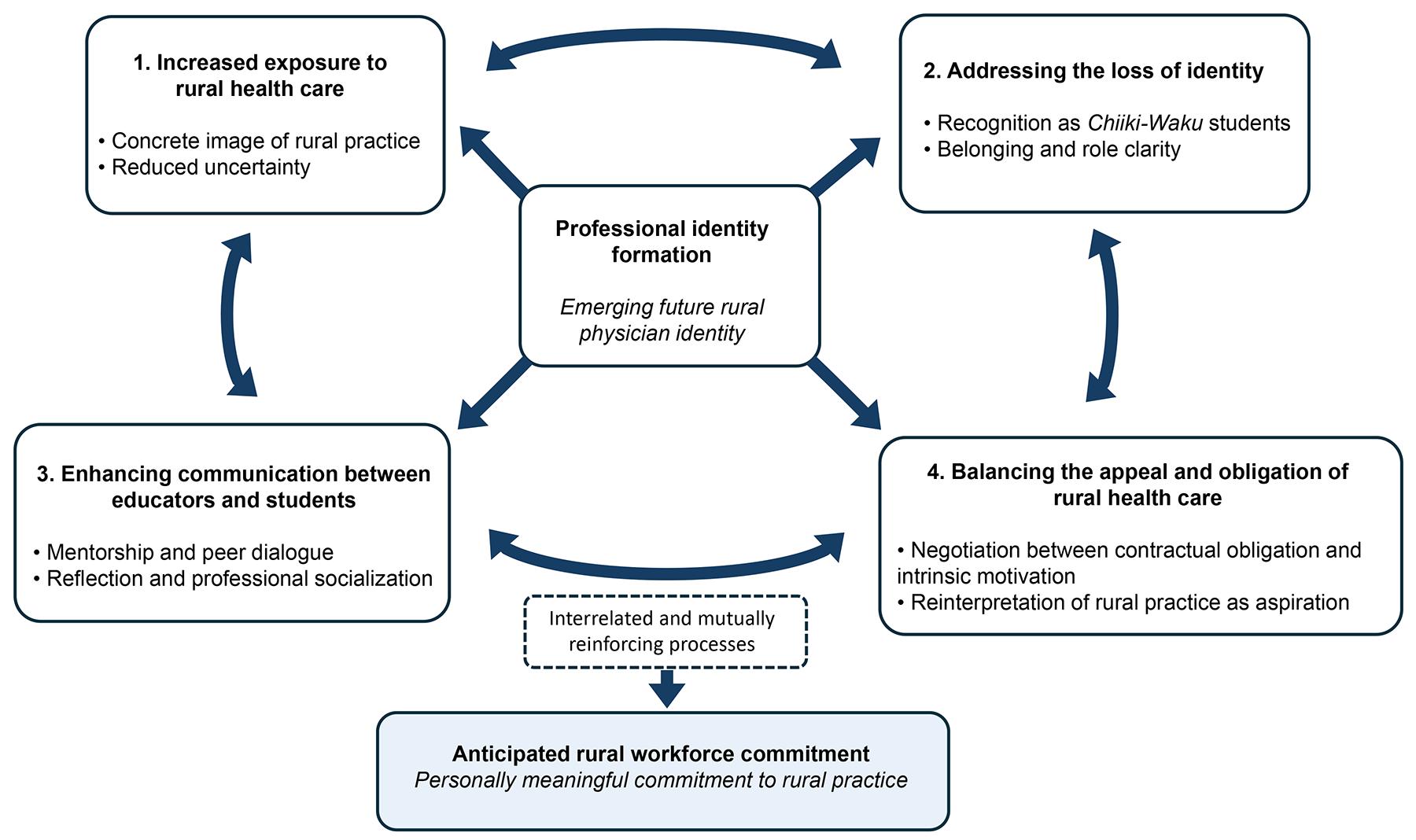 Figure 1: Conceptual framework illustrating the interrelationships among the four themes. Repeated rural exposure helped students develop a concrete image of rural practice and reduced uncertainty. Recognition of their distinct identity as Chiiki-Waku students supported belonging and role clarity. Communication with educators, mentors, and peers enabled reflection and professional socialization. These processes shaped how students negotiated the tension between contractual obligation and intrinsic motivation, contributing to professional identity formation and anticipated rural workforce commitment.
Increased exposure to rural health care
Many students expressed a sense of uncertainty and apprehension about working in remote islands or rural settings, mainly due to limited first-hand exposure during their training. This lack of familiarity fostered anxiety and a hesitancy to envision their future roles. ‘We don’t know what it’s like out there. That unknown makes it scary. I can’t even picture the kind of medicine I’m supposed to do’ (interviewee 7). While some students had participated in short-term placements, these experiences were often considered insufficient for building an accurate understanding or confidence. A single exposure, they felt, did not capture the nuances of rural practice – the isolation, the improvisational skills required, or the sense of connection with the community. ‘I had a practicum at a remote clinic. It was short, but it left a strong impression. It made me think, ‘This is why I want to be a doctor’. If more students could feel that, maybe we’d all be more motivated’ (interviewee 3). Students stressed that repeated, immersive experiences, rather than one-off visits, would better prepare them for rural practice and help them understand the rewards and challenges of such a path. ‘We need more than a taste of it. One visit is just not enough. I want to see what daily life looks like, what kind of cases come in, how the doctors handle things when they’re alone’ (interviewee 4).
Thus, rural exposure was not merely a matter of acquiring clinical experience; it provided the experiential basis for students to imagine whether rural practice could become part of their future professional identity. When such exposure was limited, students’ uncertainty about rural health care made it difficult to maintain a clear sense of purpose as Chiiki-Waku students.
Addressing the loss of identity
Another recurrent theme was a deep-seated concern about losing or diluting their identity as rural quota students. Despite entering medical school with a clear mission to contribute to underserved areas, many felt this unique role was neither acknowledged nor supported through tailored educational programs. ‘We’re supposed to be different – we joined this program because we want to do something meaningful in rural medicine, but we’re treated just like everyone else’ (interviewee 11). This absence of specialized guidance and symbolic recognition left some students questioning their place and purpose within the larger student body. Their original commitment to rural medicine began to feel peripheral rather than central. ‘I thought there would be a clear path for us – something that reminds us why we’re here. But without that, it’s hard to feel a sense of direction or pride’ (interviewee 2). Several students called for structured opportunities to reflect on their motivations and future roles. They saw such reflection as a tool for reclaiming their identity and building confidence in their journey. ‘If we were asked regularly to think about our goals and responsibilities, I think we’d start feeling proud to be in this program’ (interviewee 6).
This perceived loss of identity was closely linked to the lack of repeated rural exposure and limited institutional recognition. Students suggested that opportunities for reflection and role clarification could help reconnect their original motivation with their emerging professional identity.
Enhancing communication between educators and students
A third theme involved students’ disconnect between themselves and the educational system. Many perceived a lack of understanding or empathy from faculty members regarding the unique obligations and career pressures Chiiki-Waku students face. ‘Sometimes it feels like the professors don’t get what we’re going through. We have different worries from the other students, but there’s no space to talk about that’ (interviewee 1). The absence of open dialogue contributed to a sense of isolation and hindered students’ ability to seek advice and form meaningful mentoring relationships. Students expressed a strong desire for mentors with experience working in rural health care who could provide practical and emotional guidance. ‘I wish I had a mentor who’d worked in a remote island clinic. Just having someone who understands would help me picture my future more clearly’ (interviewee 4). Equally important was the support students found among their peers. Conversations with fellow Chiiki-Waku students helped validate their concerns and reaffirm their shared mission. Yet this peer support was often spontaneous rather than institutionally supported. ‘When I talk to other Chiiki-Waku students, I feel less alone. We understand each other, but the program doesn’t create space for those conversations to happen’ (interviewee 9).
Communication with educators, mentors, and peers, therefore, functioned as a bridge between experience and identity formation. Through such dialogue, students could reinterpret their obligations, share uncertainty, and begin to connect rural health care with their own future professional selves.
Balancing the appeal and obligation of rural health care
The final theme highlighted many students' emotional tension between external obligation and internal motivation. While the service requirement attached to the Chiiki-Waku program ensured a career path in rural medicine, it also risked transforming that path into a burdensome chore. ‘When something feels forced, I just want to get it over with. But when I find something meaningful on my own, it sticks with me’ (interviewee 5). Some students framed their career planning primarily around fulfilling the contractual obligation, rather than developing a long-term commitment to rural health care. ‘I’m already thinking about how to finish my service years quickly. That influences what kind of doctor I want to be’ (interviewee 1). However, others emphasized the potential for transformation through exposure to inspiring role models and meaningful experiences. When students met physicians who found fulfillment in rural work, their perspective shifted from obligation to aspiration. ‘If we met more doctors who love working in rural places, I think we’d start to see this as something we want, not just something we have to do’ (interviewee 8).
This theme integrated the preceding themes by showing how rural exposure, identity recognition, and supportive communication shaped whether students experienced rural practice as an imposed duty or as a personally meaningful aspiration. The transformation of obligation into intrinsic commitment appeared to be central to the development of professional identity and anticipated rural workforce commitment.
Discussion
Summary of the study
This qualitative study explored the learning experiences and identity formation of medical students admitted through the Chiiki-Waku system at the University of the Ryukyus. The findings highlighted four interrelated themes: increased exposure to rural health care, addressing the loss of identity, enhancing communication between educators and students, and balancing the appeal and obligation of rural health care. These themes suggest that students’ professional identity formation was shaped through a dynamic process. Repeated rural exposure helped students develop a concrete image of rural practice; recognition of their distinct role as Chiiki-Waku students supported belonging and role clarity; communication with educators, mentors, and peers enabled reflection and professional socialization; and these processes together influenced how students negotiated the tension between contractual obligation and intrinsic motivation. Thus, rural workforce commitment appeared to develop not simply from admission status or service obligation, but through educational experiences that helped students reinterpret rural practice as part of their future professional selves.
Theoretical interpretation of professional identity formation among Chiiki-Waku students
Interpreting our findings through the lens of professional identity formation suggests that Chiiki-Waku students’ commitment to rural health care is not a fixed attribute established at admission, but an evolving process shaped by educational experiences, relationships, and institutional recognition21. Students entered medical school through a system that explicitly positioned them as future contributors to rural and remote health care. However, their narratives showed that this externally assigned role did not automatically translate into a stable professional identity. Rather, their identity as future rural physicians required repeated reinforcement through meaningful rural exposure, interaction with role models, opportunities for reflection, and recognition of their distinct educational pathway.
Professional socialization provides a useful framework for understanding why the absence of structured educational support contributed to some students’ sense of identity loss16. When Chiiki-Waku students were treated in the same way as other students without opportunities to discuss their specific obligations, anxieties, and aspirations, their original sense of purpose became less visible within the broader medical school environment. Conversely, rural clinical placements, conversations with physicians working in remote island communities, and peer interactions among Chiiki-Waku students provided opportunities to internalize the values, responsibilities, and practical realities of rural medicine.
The concept of communities of practice further clarifies the role of rural exposure and mentorship in identity formation18. Repeated exposure to rural health care allowed students to move beyond an abstract image of rural practice and begin imagining themselves as legitimate future participants in rural healthcare communities. In this sense, rural placements, mentorship, and peer dialogue were not merely educational activities, but important forms of participation through which students developed a sense of belonging and future professional possibility. Our findings therefore suggest that the contractual obligation embedded in the Chiiki-Waku system may contribute to workforce distribution, but obligation alone is insufficient to sustain long-term rural commitment. Educational environments need to help students transform obligation into personally meaningful aspiration through participation, reflection, and relational support.
The four themes can therefore be understood as an interconnected process of professional identity formation. Increased exposure to rural health care provided the experiential foundation that enabled students to move from an abstract or uncertain image of rural medicine towards a more concrete imagination of future practice. Addressing the loss of identity represented the need for institutional recognition and role clarity, without which students’ initial motivation could become diluted within the general medical school environment. Enhancing communication between educators and students functioned as a mediating mechanism, allowing students to reflect on their experiences, receive guidance from mentors, share concerns with peers, and internalize the values of rural health care. Balancing the appeal and obligation of rural health care represented the outcome of this interpretive process, in which students negotiated whether rural practice would remain an externally imposed duty or become a personally meaningful professional aspiration. In this model, professional identity formation and anticipated rural workforce commitment emerge through the interaction of experience, recognition, dialogue, and reflection rather than through contractual obligation alone.
Novel contribution of this study
The main contribution of this study is clarifying how professional identity formation among Chiiki-Waku students is shaped by the tension between contractual obligation and intrinsic motivation. Previous studies on rural medical education and Chiiki-Waku systems have emphasized the importance of rural exposure, admission pathways, scholarships, and workforce policies for improving recruitment and retention22,23. However, less attention has been paid to how students themselves experience and reinterpret the obligation embedded in such systems during undergraduate education.
Our findings suggest that Chiiki-Waku students do not simply maintain the motivation they had at admission, nor do they automatically develop long-term commitment because of their service obligation. Rather, their commitment appears to form through an ongoing process in which they encounter rural health care, seek recognition as Chiiki-Waku students, communicate with educators and peers, and reflect on whether rural practice can become part of their future professional selves. This process-oriented understanding provides a new perspective on Chiiki-Waku education by showing that the sustainability of rural workforce commitment depends not only on policy design, but also on whether educational environments help students transform obligation into personally meaningful aspiration.
This insight is particularly relevant in the Japanese context, where the Chiiki-Waku system has been widely implemented as a policy response to rural physician shortages. The findings suggest that the effectiveness of this system may be strengthened when medical schools move beyond simply fulfilling contractual or administrative requirements and instead provide educational structures that support identity formation, belonging, and reflective engagement with rural practice. In this sense, the study extends existing literature by linking rural workforce commitment with professional identity formation and by foregrounding the emotional and educational process through which obligated service may become self-endorsed professional commitment.
Relationship with previous publications and contribution of the present study
The present study should be understood in relation to, but distinct from, three previous publications arising from the same broader qualitative research project. The first study clarified why students chose the Chiiki-Waku admission pathway, showing that their decisions were shaped by both practical considerations and value-based motivations13. The second study examined learning challenges and coping mechanisms during medical school, highlighting feelings of inferiority, policy-related uncertainty, emotional strain, and the importance of interpersonal support14. The third study investigated how students’ specialty preferences developed during medical education, focusing on evolving career aspirations, specialty restrictions, and ambivalence towards general practice15.
The present study extends these published articles by offering a theoretically informed interpretation of how Chiiki-Waku students’ educational experiences shape professional identity formation and anticipated rural workforce commitment. Although some empirical materials necessarily relate to similar experiences, such as obligation, rural exposure, and interpersonal support, the analytical purpose and interpretation are different. Here, these experiences are not treated primarily as reasons for applying, general learning challenges, or determinants of specialty choice. Instead, they are interpreted as components of a professional identity formation process through which students negotiate the tension between externally imposed service obligations and their own emerging aspirations as future rural physicians. This distinction is important because it shifts the focus from describing separate aspects of students’ experiences to explaining how educational environments may support the transformation of obligation into personally meaningful rural workforce commitment.
Comparisons with other studies
Our findings both align with and extend previous research on rural medical education and Chiiki-Waku systems. Consistent with prior studies, our participants emphasized the importance of meaningful clinical exposure in rural settings for sustaining interest in underserved communities22,23. Previous studies have shown that short-term rural placements often fall short in fostering lasting motivation compared with longitudinal and immersive experiences24-26. However, the present study adds to this literature by showing that rural exposure is not only a means of increasing interest in rural practice but also a key process through which students begin to imagine themselves as future rural physicians.
Similarly, concerns about identity loss among Chiiki-Waku students echo earlier findings that specialized admission pathways must be accompanied by continuous educational and social support to sustain students' initial mission-driven motivations27,28. Furthermore, the lack of proactive communication and mentorship observed in this study parallels issues reported in other regions where medical educators were insufficiently attuned to the distinct pressures faced by students in rural service programs29-32. However, our study extends previous research by showing how the emotional tension between contractual obligation and intrinsic motivation functions as a central process in professional identity formation among Chiiki-Waku students33. In the Japanese Chiiki-Waku system, students are institutionally positioned as future rural physicians from the time of admission, yet their narratives showed that this assigned role may remain unstable unless it is reinforced through meaningful educational experiences and relational support. Rather than viewing rural workforce commitment as a direct outcome of admission status or service obligation, our findings suggest that commitment develops through professional socialization, participation in rural healthcare communities, and reflective opportunities that help students reinterpret obligation as a personally meaningful professional aspiration.
Strengths of the study
A major strength of this study lies in its focus on the perspectives of students across different academic years, allowing for the observation of how motivations and professional identity evolve. The use of semi-structured interviews enabled in-depth exploration of complex feelings and experiences that are difficult to capture through quantitative methods alone. The involvement of researchers with diverse backgrounds, including those from the Chiiki-Waku, enhanced the reflexivity and richness of the analysis. Additionally, conducting the study at the University of the Ryukyus, located in a geographically isolated region with distinct healthcare challenges, provides a unique lens through which to examine the realities of rural medical education in Japan.
Another strength is that the study does not treat rural workforce commitment as a simple outcome of admission status or scholarship obligation. Instead, it offers a process-oriented interpretation of how Chiiki-Waku students’ commitment may be shaped through professional identity formation, socialization, and participation in rural healthcare communities. This conceptual focus allows the study to identify educational points at which medical schools may support students in transforming obligation into personally meaningful professional commitment.
Limitations
Several limitations should be noted. First, the study was conducted at a single institution, which may limit the transferability of the findings to other settings with different rural characteristics or educational structures. In particular, Okinawa Prefecture has a geographically and culturally distinctive context, including remote islands, distance from mainland Japan, and local healthcare access challenges. These contextual features may have shaped students’ perceptions of rural health care, island medicine, professional identity, and service obligation. Therefore, the findings should be interpreted with attention to this Okinawan context and may not be directly transferable to other regional quota programs in Japan or to rural admission pathways in other countries. Second, self-selection bias may have influenced the participant pool: students with stronger feelings about their Chiiki-Waku experience may have been more likely to participate. Third, the participants were limited to medical students in their pre-clinical years. Consequently, this study does not capture the perspectives of students during or after their clinical clerkships. Given that direct experience in clinical settings and rural hospitals can significantly shift a student's outlook and professional identity, these stages remain an important area for future research. Fourth, as with all qualitative research, findings are interpretative and shaped by interactions between interviewers and participants. Although credibility was enhanced through independent coding, team-based discussion, analyst triangulation, comparison of themes with original transcripts, and contextual review by a medical educator familiar with the Chiiki-Waku program, formal participant member checking was not conducted. This may have limited opportunities for participants to comment directly on the researchers’ interpretations. Finally, this study was conducted as part of a broader qualitative project from which three related articles have been published. Although the present article addresses a distinct research question and applies a different theoretical lens, some overlap in participants and contextual background is unavoidable. To ensure transparency, we have explicitly described the relationship between the present study and the previous publications, and clarified how the analytical focus and contribution of this manuscript differ from those earlier works.
Conclusion
This study highlights that professional identity formation among Chiiki-Waku students is not a fixed attribute established at admission, but an educationally and socially shaped process. Students’ commitment to rural health care developed through repeated rural exposure, recognition of their distinct role as Chiiki-Waku students, communication with educators and peers, mentorship, and opportunities for reflection. A key insight of this study is that these experiences helped students negotiate the tension between contractual obligation and their emerging personal aspirations as future rural physicians. Medical schools should therefore provide continuous and meaningful rural exposure, specialized educational support, and structured opportunities for mentorship and reflection. Such support may help students develop personally meaningful professional commitment and may inform educational strategies for strengthening rural workforce sustainability.
Funding
This research received no specific grant from funding agencies in the public, commercial, or not-for-profit sectors.
Conflicts of interest
The authors declare no competing interests.
AI disclosure statement
During the preparation of this manuscript, the authors used ChatGPT (OpenAI) and Grammarly to assist with language editing and improvement of clarity. The authors reviewed and edited all AI-assisted output, verified the accuracy of the content, and take full responsibility for the final version of the manuscript.
Availability of data and materials
The datasets generated and/or analyzed during the current study are not publicly available due to the risk of identifying individual participants, but are available from the corresponding author on reasonable request and with permission from the institutional ethics committee.
References
You might also be interested in:
2018 - Primary health care nurses' competencies in rural disasters caused by floods
2012 - Physician in practice clinic: educating GPs in endocrinology through specialist-outreach